
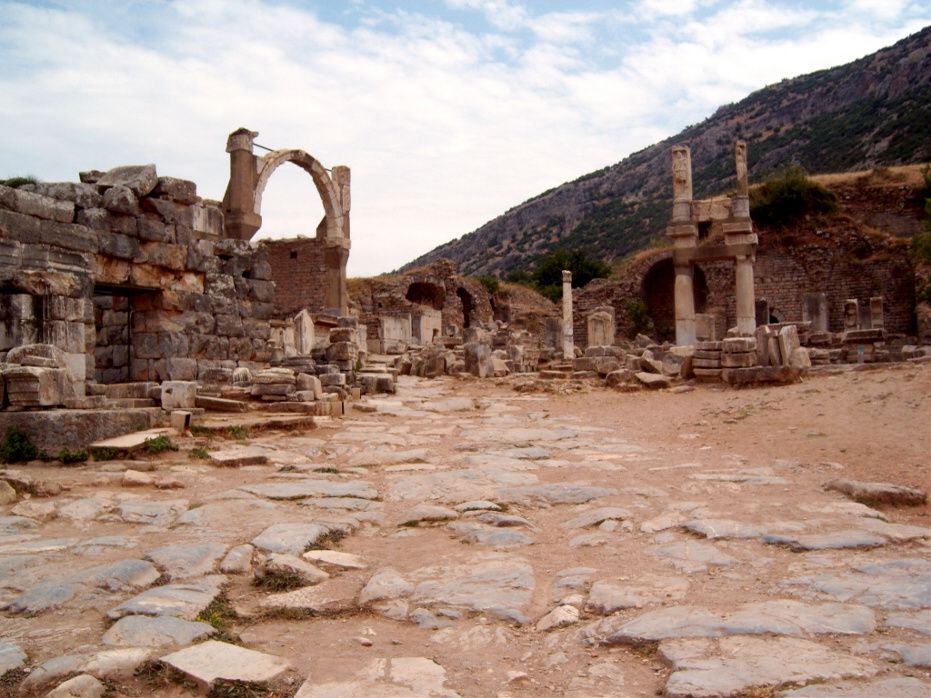
Ephesus was abandoned because its harbor silted up, its streets were shaken by earthquakes and burned by raiders, and the trade, government and faith that had kept it alive moved elsewhere. No single blow ended it: the capital of Roman Asia became a field of marble over more than a thousand years, deserted by the 15th century.
Why was Ephesus abandoned?
Ephesus was abandoned because the sea left it, the ground kept shaking under it and its rulers stopped investing in it. The harbor silted up despite centuries of dredging. Earthquakes and raiders wrecked the lower city again and again. And the capital, the trade and the new Christian faith all pulled life uphill to Ayasuluk and away to Constantinople.
The river won: a harbor that kept filling
When Lysimachus rebuilt the city around 290 BC it stood right on the Aegean. The Kucuk Menderes, the ancient Cayster, carried silt into the bay every winter. Kings and emperors rebuilt, dredged and rechanneled the harbor for centuries. Ships still reached Ephesus until about the 7th century AD, then no more.
Earthquakes, Goths, a war fire and Arab fleets
The great earthquake of AD 17 damaged the city; Tiberius funded the rebuilding. In the 260s AD an earthquake and Gothic sea-raiders struck within a few years of each other. Around 614–615 whole streets of the lower city burned. Arab fleets raided in 654–655, 700 and 716, and the raid of 781 carried off about 7,000 captives.
Faith and capital moved on
The Temple of Artemis, which had drawn pilgrims and money for nearly a thousand years, was closed in the early 5th century and quarried for building stone. Wealth flowed to Constantinople instead. When Justinian built the Basilica of St John on Ayasuluk Hill in the 6th century, the city's new heart was about 3 km from the old one.
You can see the whole story from one spot. Stand by the single column of the Temple of Artemis and look up: the basilica and the fortress on Ayasuluk mark where the people went. The marble city itself lies a short drive beyond, in a valley that now opens onto fields, not water.
What happened to Ephesus: the timeline
This is the chronology our guides use on the walk, with only the dates the sources support. Where historians disagree we say so. The full three-thousand-year table is in our timeline of Ephesus.
- c. 1400–1300 BC — Apasa, capital of Arzawa, stands on Ayasuluk Hill: the first Ephesus.
- c. 1000 BC — Greek settlers found Ionian Ephesus; legend names Androklos of Athens as the founder.
- c. 560 BC — Croesus of Lydia takes the city. The great Temple of Artemis is begun around 550 BC.
- 356 BC — The temple burns, traditionally on the night Alexander the Great is born. In 334 BC Alexander offers to pay for the rebuilding; the Ephesians decline.
- c. 290 BC — Lysimachus refounds the city on the present site, right on the coast.
- 133–129 BC — Ephesus passes to Rome. In 27 BC Augustus makes it the capital of the province of Asia.
- AD 17 — A great earthquake damages the city (some scholars date the Ephesus damage to AD 23); Tiberius funds the repairs.
- AD 52–55 — Paul spends about three years in the city. The Library of Celsus is begun c. 114–117 and finished c. 135.
- AD 262/263 — An earthquake dated 21 December 262 and Gothic raids hit the coast. The library interior burns and the Temple of Artemis is sacked (sources give 262, 263 or 268).
- Early 5th century — The Temple of Artemis is closed and quarried for stone. The Second Council of Ephesus meets here in 449.
- 6th century — Justinian builds the Basilica of St John on Ayasuluk Hill.
- 614/615 — Much of the lower city burns, most likely during the Persian war. Ships still reach the harbor until about the 7th century, then never again.
- 654–781 — Arab raids in 654–655, 700 and 716; the raid of 781 carries off about 7,000 captives. The people withdraw to the fortified hill.
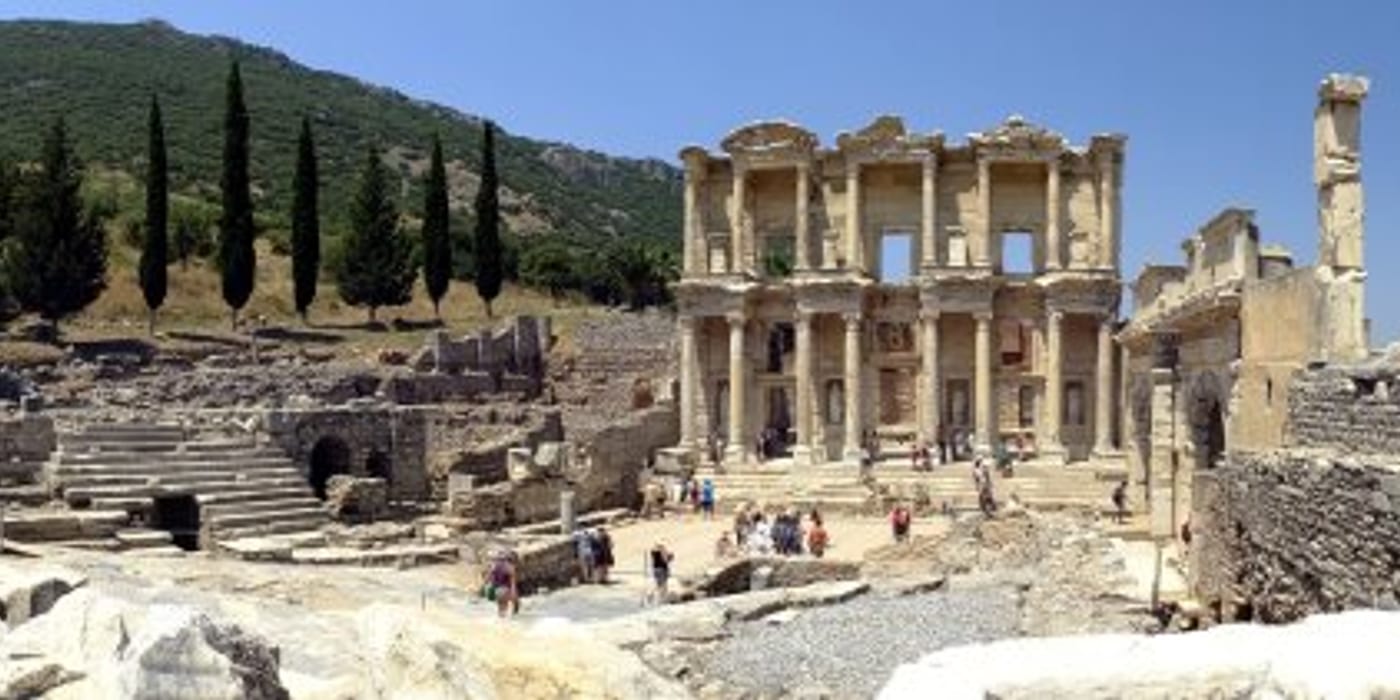
- 10th–11th century — An earthquake brings down the facade of the Library of Celsus.
- 1090–1097 — The Seljuks take and plunder the town; the Byzantines recover it in 1097.
- October 1304/1305 — Ayasuluk surrenders to Sasa Bey. It is the capital of the Aydin emirate from 1348 to 1390, and the Isa Bey Mosque is built in 1374–75.
- 1390–1425 — Ottoman vassalage in 1390, Timur's interlude in 1402, Ottoman rule for good in 1425. The ancient city below is deserted by the 15th century.
- 1863–1895 — John Turtle Wood finds the Temple of Artemis under about 6 m of sand on 31 December 1869; Austrian excavations begin in 1895 and continue today (updated September 2026).
When was Ephesus destroyed?
Ephesus was never destroyed in a single event. It was damaged many times: the earthquake of AD 17, the earthquake and Gothic raids of the 260s AD, the fire of 614/615, the Arab raids of the 7th and 8th centuries, and the collapse of the library facade in the 10th or 11th century. Each time, less was rebuilt.
The Gothic sack of the 260s AD
The date you will see most often is AD 262 or 263, when the Goths sacked the city and burned the Temple of Artemis; some sources say 268. An earthquake dated 21 December 262 struck the same coast with a tsunami. The Library of Celsus interior burned in 262; nobody can say whether quake or raiders lit the fire.
Who were the Goths? A Germanic people who, by the 3rd century AD, had settled north of the Black Sea and the lower Danube, in what is now Ukraine, Moldova and Romania. From the 250s they and their allies raided the Roman coasts by sea, in ships the Bosporan Kingdom in Crimea was pressured into supplying.
How did the Goths get all the way to Ephesus? By water. Jordanes, writing in the 6th century, says the Gothic leaders Respa, Veduc and Thuruar "took ship and sailed across the strait of the Hellespont to Asia," where they "laid waste many populous cities" and burned the temple. A bigger raid around 267–268 took the whole sea road: a fleet said to number 500 ships came down from the Black Sea, sacked Byzantium and Cyzicus, and went on to raid the Aegean and Greece as far as Athens. That is why the date of the temple fire wavers between 262/263 and 268.
What burned, and why? The prize was the Temple of Artemis, the richest sanctuary on the coast, where kings, cities and private citizens had deposited money for centuries; our Temple of Artemis page tells what was left of it. In 262 the interior of the Library of Celsus burned too, scrolls and all, though that fire may have been the earthquake's work. The raiders plundered and sailed on. Ephesus recovered and stayed a large late Roman city, but the temple never regained its old glory, and many histories date the start of the decline from these raids.
The fire of 614/615 at Domitian Square
For decades guidebooks blamed an earthquake in 614 for wrecking the lower city. Excavations at Domitian Square since 2022, right beside the path our groups take from the Odeon down to Curetes Street, tell a different story.
The diggers found Late Antique shops, workshops and a tavern sealed under fire debris, with gold coins and about 700 pilgrim flasks left behind. The best explanation is fire during the Persian (Sasanian) war, in 614/615.
Why is Ephesus no longer on the coast?
Ephesus is no longer on the coast because the Kucuk Menderes river, the ancient Cayster, filled the bay with silt. Lysimachus built his city at the river mouth around 290 BC, on the shore of the Aegean. Today the shoreline at Pamucak beach lies roughly 5–6 km west of the ancient harbor basin.
Was Ephesus a port city? Yes. Attalos II of Pergamon rebuilt the harbor in the 2nd century BC. Under Nero a proconsul dredged it. Hadrian diverted the river to keep the channel open. Ships could still reach the city until about the 7th century AD.
Walk Harbor Street down from the Great Theater and you feel the answer underfoot. The marble avenue runs dead level to the west and stops at the site fence; beyond are fields, then the delta, then a sea you cannot see. The old harbor basin is the low, marshy ground past the end of the street.
Is Ephesus still a city today?
No. Ephesus is an archaeological site, not a living city; nobody has lived among these ruins since the 15th century. The town that carries the story on is Selcuk: about 38,500 people (TurkStat, 2025), 3 km from the lower gate. It grew out of Ayasuluk, the hill the last Ephesians moved to, and took its present name in 1914.
Ayasuluk comes from the Greek Agios Theologos, Saint John the Theologian, whose basilica stood there from the 6th century. The fortress went up after the Arab raids of the 7th century to protect it. The Isa Bey Mosque of 1375 below it shows a town thriving on the hill while the marble city beneath was fading.
Austrian teams have excavated here since 1895, and after more than 130 years of Austrian excavation only about a tenth of the ancient city has been uncovered. Ephesus has been a UNESCO World Heritage Site since 2015.

How old is Ephesus?
Ephesus is about 3,000 years old as a Greek city, founded around 1000 BC, and far older as a place. Bronze Age Apasa, capital of Arzawa, stood on Ayasuluk Hill around 1400–1300 BC, and the director of the dig there speaks of roughly 9,000 years of unbroken settlement. The city stayed alive for roughly 2,400 years, until the 15th century.
The streets you walk are mostly Roman: the Library of Celsus was finished around AD 135 and the Temple of Hadrian dedicated around AD 138, when Ephesus was the capital of Roman Asia.
See the decline of Ephesus with a private guide
The marks of the decline are easy to walk past without someone pointing. Our licensed local guides show you the dig at Domitian Square, marble from the Temple of Artemis reused in the old aqueduct in Selcuk, and the harbor end of the street where the quays met water now 5–6 km away.
- Private only: your party of 1 to 44 travelers, never mixed with strangers; guiding in English, Spanish, Portuguese, French, Russian, Italian or German.
- From $37 per person, with skip-the-line entry at every gate; tickets bought for you at the Ministry gate price, no mark-up (updated September 2026).
- Lunch included at a local artisan center: whatever is local and fresh, cooked by local chefs.
- No prepayment, so no cancellation fee; we reply within 24 hours, any day.
- Cruise guests: pickup at the gangway with a name sign, and back at the ship on time, guaranteed. See our Kusadasi cruise port guide.
The silted harbor and the move uphill are easier to see than to read about, and our private Ephesus tours walk the old shoreline on the way to the lower gate. Want the Basilica of St John and the fortress added? Use our create-your-own tour or tell us on the booking form which ship or hotel you are coming from; we reply within 24 hours.
Sources & further reading
- UNESCO World Heritage Center: Ephesus — the World Heritage listing of 2015
- Austrian Archaeological Institute (OeAI), Ephesos branch — the excavations since 1895 and the Domitian Square project
- Leiden University: Ephesus research project — how much of the ancient city has been excavated
- Stock, Pint, Ladstätter and Brueckner, In search for the harbors, Quaternary International 312 (2013) — geoarchaeology of the silted harbors and the moving shoreline
Keep reading
See all Ephesus travel articlesEphesus Meaning: Origin of the Name and What Efes Means
What Ephesus means, where the name comes from, and what Efes means in Turkish, from guides who say it every day.
Alexander the Great, Lysimachus and the City That Moved
Alexander offered to rebuild the burned wonder; the Ephesians talked their way out. Then his general moved the whole city — with plumbing as the weapon.