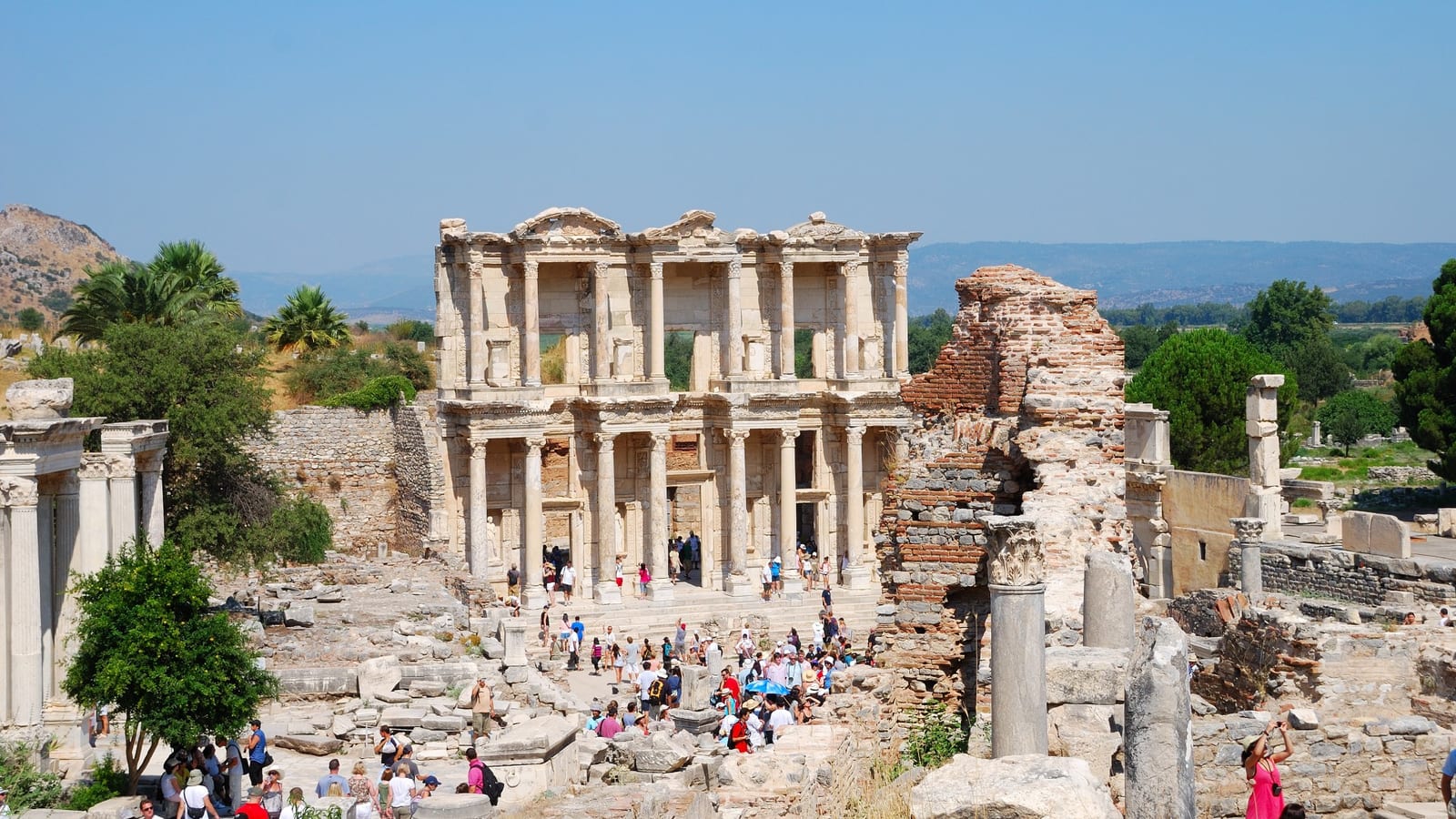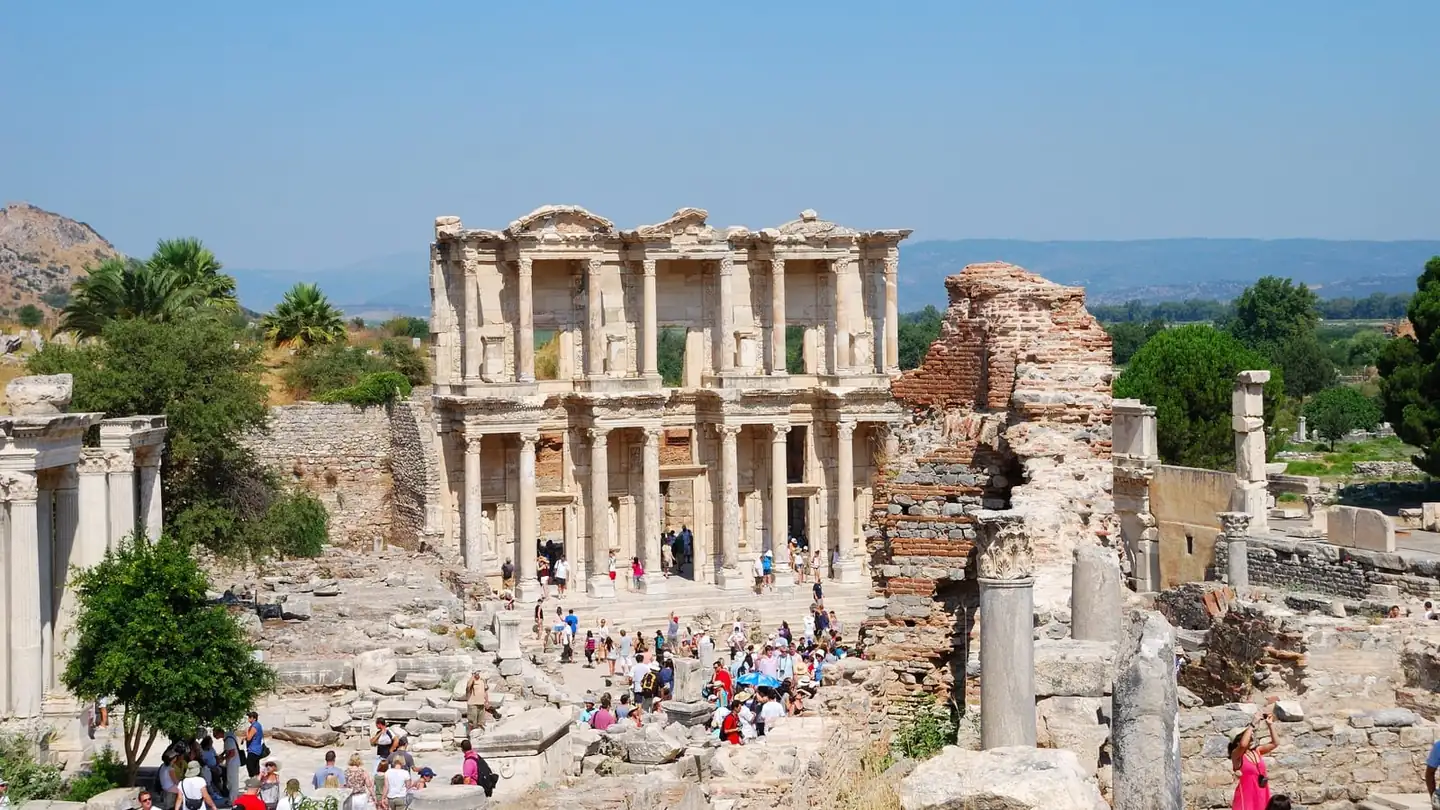
Ephesus is about 3,000 years old as a Greek and Roman city and much older as a place: Greek colonists founded it around 1000 BC on a hill that had already been the Bronze Age town of Apasa, and the last inhabitants left the marble city in the 15th century. Between those two dates it was Ionian, Lydian, Persian, Hellenistic, Roman, Byzantine, Seljuk and Ottoman — and since 1863 it has belonged to the archaeologists.
Ephesus history timeline
| Date | Event |
|---|---|
| c. 1400–1300 BC | Apasa, capital of the kingdom of Arzawa, flourishes on Ayasuluk Hill — the first Ephesus. |
| c. 1000 BC | Attic and Ionian Greek settlers found Ephesus; legend names the Athenian prince Androklos as founder. |
| c. 560 BC | King Croesus of Lydia takes the city and helps pay for a new Temple of Artemis, begun about 550 BC. |
| 356 BC | The Temple of Artemis burns — traditionally on 21 July, the night Alexander the Great is born; Herostratus takes the blame. |
| 334 BC | Alexander frees Ephesus from Persian rule and offers to fund the temple's rebuilding; the Ephesians politely decline. |
| c. 290 BC | Lysimachus refounds the city on its present site, right on the Aegean shore. |
| 133–129 BC | The last king of Pergamon leaves his kingdom to Rome; Ephesus becomes part of the Roman province of Asia in 129 BC. |
| 88–86 BC | The Mithridatic uprising: some 80,000 Roman citizens are killed across Asia; Sulla retakes the city in 86 BC. |
| 27 BC | Augustus makes Ephesus the capital of proconsular Asia instead of Pergamon — the start of its golden age. |
| AD 17 | A great earthquake damages Ephesus and a dozen other cities; Tiberius funds the rebuilding. |
| c. AD 52–55 | The apostle Paul lives and preaches in Ephesus for about three years (Acts 19). |
| c. AD 114–135 | The Library of Celsus is begun in the 110s and completed under Hadrian. |
| c. AD 138 | The Temple of Hadrian on Curetes Street is dedicated. |
| AD 262–263 | An earthquake and Gothic sea-raids strike within a few years; the library's interior burns and the Temple of Artemis is sacked (sources give 262, 263 or 268). |
| AD 431 | The Council of Ephesus proclaims Mary Theotokos, Mother of God; a second council follows in 449. |
| late antiquity | The Temple of Artemis is closed and quarried for building stone. |
| AD 548–565 | Emperor Justinian builds the Basilica of Saint John on Ayasuluk Hill. |
| AD 614–615 | Whole streets of the lower city burn — long blamed on an earthquake, now traced by the 2022 excavations to the Persian war. |
| AD 654–781 | Arab raids in 654–655, 700 and 716; in 781 about 7,000 people are carried off. The harbor, kept alive by dredging, is unusable after the 600s. |
| 1090 / 1097 | Seljuk Turks take the city; the Byzantines win it back seven years later. |
| October 1304/1305 | Ayasuluk surrenders to the Turkish warlord Sasa Bey; the Aydin emirate rules from here (capital 1348–1390). |
| 1375 | The Isa Bey Mosque is completed in Selcuk. |
| 1390–1425 | Ottoman rule, interrupted by Timur in 1402 and made permanent in 1425. The ancient city below is deserted by the 15th century. |
| 1863–1869 | John Turtle Wood searches for the Temple of Artemis and finds it on 31 December 1869 under about 6 m of sand. |
| 1895 | Austrian excavations begin under Otto Benndorf; they continue today, with a pause in 2016–2018. |
| 1970–1978 | The facade of the Library of Celsus is re-erected from its fallen blocks. |
| 2015 | Ephesus joins the UNESCO World Heritage List. |
Timeline of the different civilizations in Ephesus
Bronze Age: Apasa (before 1000 BC)
Before there was an Ephesus there was Apasa, the capital of Arzawa, a kingdom known from Hittite records. Its fortified hill is believed to be Ayasuluk Hill in Selcuk, where Mycenaean pottery and a Late Bronze Age wall have been found under the later basilica. The name Ephesus itself probably descends from Apasa — the story is in our article on the meaning of Ephesus.
Ionian Greeks, Lydians and Persians (c. 1000–334 BC)
Greek colonists settled the hill around 1000 BC. Croesus of Lydia conquered the city around 560 BC and paid for a new Temple of Artemis, begun about 550 BC and, according to Pliny, some 120 years in the building. Persia took Anatolia in the 540s; the temple burned in 356 BC; Alexander arrived in 334 BC.
Hellenistic Ephesus (c. 290–129 BC)
Lysimachus, one of Alexander's generals, moved the whole city to the valley you visit today and wrapped it in walls. The full story of the move, drains and all, is in Alexander, Lysimachus and the city that moved.
Roman Ephesus (129 BC – AD 395)
Under Augustus the city became the capital of Asia and one of the largest cities of the Roman East. Older textbooks give figures up to about 225,000 people, but the two most recent systematic studies put it at roughly 34,000 to 72,000. This is the Ephesus of the Library of Celsus, the Terrace Houses and the Great Theater — and of Paul's three years.
Byzantine Ephesus (395–1304)
Christian councils in 431 and 449, Justinian's basilica over Saint John's tomb, then the slow strangling of the harbor by the river, fire in 614/615, Arab raids from 654 and the retreat of the population up the hill. Why the city died is told in the decline of Ephesus.
Seljuk and Ottoman Ayasuluk (1304–1923)
The Turkish emirs of Aydin made Ayasuluk their capital and built the Isa Bey Mosque in 1375, partly from Ephesian marble. The Ottomans took over for good in 1425. The valley below was deserted by the 15th century; the town on the hill became Selcuk in 1914 and is the modern-day Ephesus of today.
Was Ephesus Greek or Roman?
The two words describe different things. Greek was the city's language and culture from its founding, through its centuries as one of the twelve Ionian cities, and on through the Roman and Byzantine years: its council and assembly, its festivals of Artemis, its philosopher Heraclitus and most of its inscriptions are Greek. Even the street grid began as Greek, laid out when King Lysimachus refounded the city around 290 BC (the story is in Alexander, Lysimachus and the city that moved); under Augustus the Romans laid a second grid over parts of it. Rome supplied the government, the peace and much of the money, and most of the marble you walk past went up under the emperors in the first and second centuries AD. Ephesus was a Greek city in the Roman Empire, and it saw no contradiction in that.
Was it ever in Greece? No. Ephesus has always stood on the Asian shore of the Aegean, in the region the Greeks called Ionia and the Romans the province of Asia; today that is Izmir Province in Turkey. The confusion is understandable: Greek was spoken here for more than two thousand years, the Greek Orthodox villagers of nearby Sirince stayed until the population exchange of 1923, and the Greek island of Samos is in sight across the water from Kusadasi.
Our guides point out the Greek and the Latin on that same gate on the Best of Ephesus Tour, a private half day that also takes in the House of the Virgin Mary and the Temple of Artemis.
How old is Ephesus?
About 3,000 years as a Greek and Roman city, counting from the Ionian founding around 1000 BC; the Bronze Age settlement on Ayasuluk Hill is older still, and its excavators speak of roughly 9,000 years of continuous settlement on the hill. The marble city you walk was laid out around 290 BC and reached its peak in the first and second centuries AD, so most of what you photograph is around 1,900 years old.
Timeline of the excavations and restoration
- 1863–1874 — John Turtle Wood. The British engineer searches for the Temple of Artemis on behalf of the British Museum and finds it on 31 December 1869, under about 6 m of sand.
- 1895 — the Austrians arrive. Otto Benndorf begins the excavations that the Austrian Archaeological Institute (founded 1898) has led ever since; after more than 130 years, only about a tenth of the city has been uncovered.
- 1970–1978 — the Celsus facade rises again. The library's front is rebuilt from its fallen blocks, creating one of the most photographed views in Turkey.
- 2015 — World Heritage. UNESCO lists Ephesus, including Ayasuluk Hill and the House of the Virgin Mary.
- 2016–2018 — a pause, then a restart. Turkey halted the Austrian work in October 2016 and allowed it to resume in May 2018.
- 2022 onward — Domitian Square. New excavations uncover streets of shops and a tavern sealed under fire debris from 614/615 — rewriting the story of how the lower city ended.
Sources & further reading
- UNESCO World Heritage Center: Ephesus — the 2015 listing
- Austrian Archaeological Institute — Ephesos — the excavations since 1895
- Wikipedia: Ephesus — chronology cross-checked against the sources it cites
- John Turtle Wood — the discovery of the Temple of Artemis in 1869
Keep reading
See all Ephesus travel articlesThe Decline of Ephesus: Why the City Was Abandoned
Why Ephesus was abandoned, when it fell and what happened to the city: silt, earthquakes, Goths, Arabs and a slow move uphill, with dates.
Judaism in Ephesus
Josephus, Roman Sabbath decrees and a menorah on the library steps — the evidence for Jewish life in ancient Ephesus.