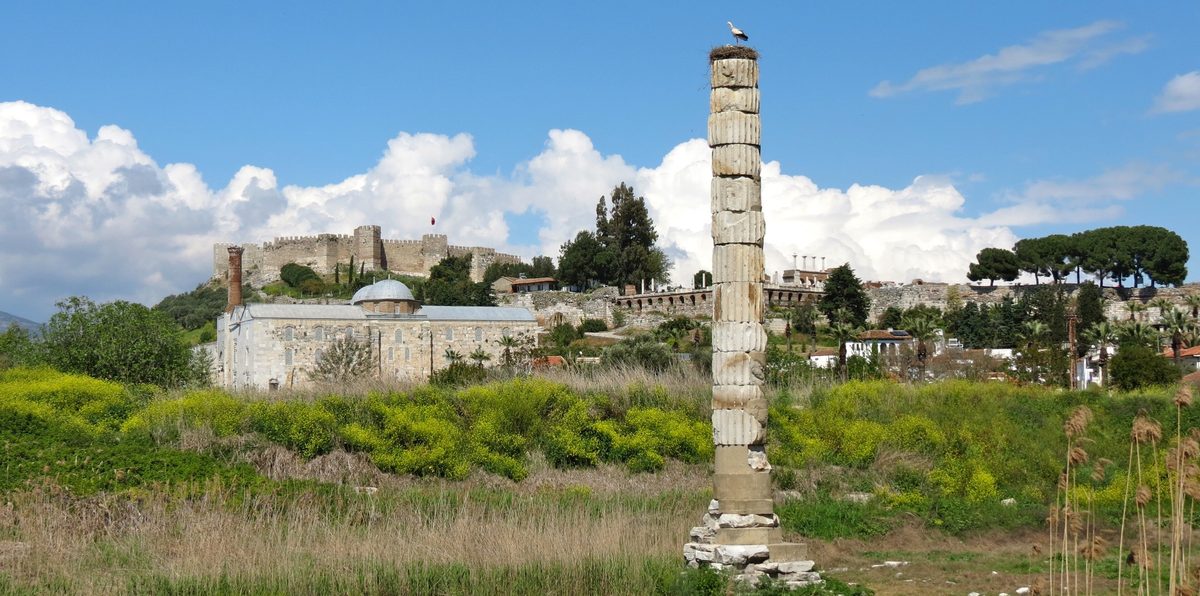
The Temple of Artemis and the Temple of Diana are the same building: Diana was the Roman name for the Greek goddess Artemis, and the temple that stood beside the road into Ephesus was one of the Seven Wonders of the Ancient World. Today a single column marks the site in a marshy field in Selcuk, and it is free to visit at the time of writing.
Temple of Diana or Temple of Artemis?
Both names are correct. The Ephesians worshipped Artemis, an Anatolian mother goddess in Greek dress; when Rome ruled the city, Latin writers equated her with their own Diana and the building became the Temple of Diana — the name it kept in English guidebooks for centuries. The Goths, wrote the historian Jordanes, "set fire to the renowned temple of Diana at Ephesus." The goddess herself, with her rows of oval pendants and her belt of bees, was nothing like the slim huntress of Roman art; you meet her face to face in the Ephesus Museum.
Is Ephesus one of the Seven Wonders of the Ancient World?
The city is not; its temple is. The Temple of Artemis appears on every ancient list of the Seven Wonders alongside the Pyramids, the Hanging Gardens, the statue of Zeus at Olympia, the Mausoleum at Halicarnassus, the Colossus of Rhodes and the Lighthouse of Alexandria. Antipater of Sidon, who wrote the list down in the second century BC, said that when he saw "the house of Artemis that mounted to the clouds, those other marvels lost their brilliancy." It is the only Wonder of the seven that stands in Turkey, apart from the Mausoleum's foundations in Bodrum.
Temple of Diana facts
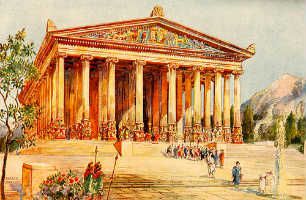
- Begun around 550 BC with money from King Croesus of Lydia; according to Pliny it took about 120 years to complete. The first marble temple measured about 115 m by 46 m, with columns 13 m high.
- Burned in 356 BC, traditionally on 21 July, the night Alexander the Great was born; the arsonist Herostratus wanted to be famous. Legend says Artemis was away attending Alexander's birth and could not save her house.
- Rebuilt larger after 356 BC: roughly 130–137 m long and 69 m wide, with 127 columns about 18 m high (Pliny's figures). Alexander offered to pay for it in 334 BC; the Ephesians declined the honor.
- Sacked by the Goths in the 260s AD — sources give 262, 263 or 268 — and never fully restored.
- Closed in late antiquity as Christianity took over, and quarried for building stone; some of its marble ended up in Justinian's basilica and in the Isa Bey Mosque up the hill.
- Found again on 31 December 1869 by the British engineer John Turtle Wood, under about 6 m of sand, after a six-year search.
Did the Goths destroy the Temple of Artemis?
Partly. Gothic sea-raiders burned the temple during their raids on Asia Minor in the 260s AD — sources give 262, 263 or 268. How badly it was damaged is unknown; it may have been patched and kept in use, but it never regained its old glory. It was closed in late antiquity and quarried for stone.
It was the obvious prize. For centuries the Artemision had been the richest sanctuary on the coast, a place where kings, cities and private citizens deposited their money, because robbing a goddess counted as sacrilege rather than simple theft. The historian Jordanes, writing almost three centuries after the raid, even names the Gothic leaders: Respa, Veduc and Thuruar. What followed was slow loss rather than one great blow: closure as Christianity took over, then the quarrying listed above, with much of the marble that was not reused burned for lime.
Who the Goths were, and how their ships got from the Black Sea into the Aegean, is told in our article on the decline of Ephesus; the Ephesus timeline sets the raid among the city's other disasters.
What is left of the Temple of Artemis today
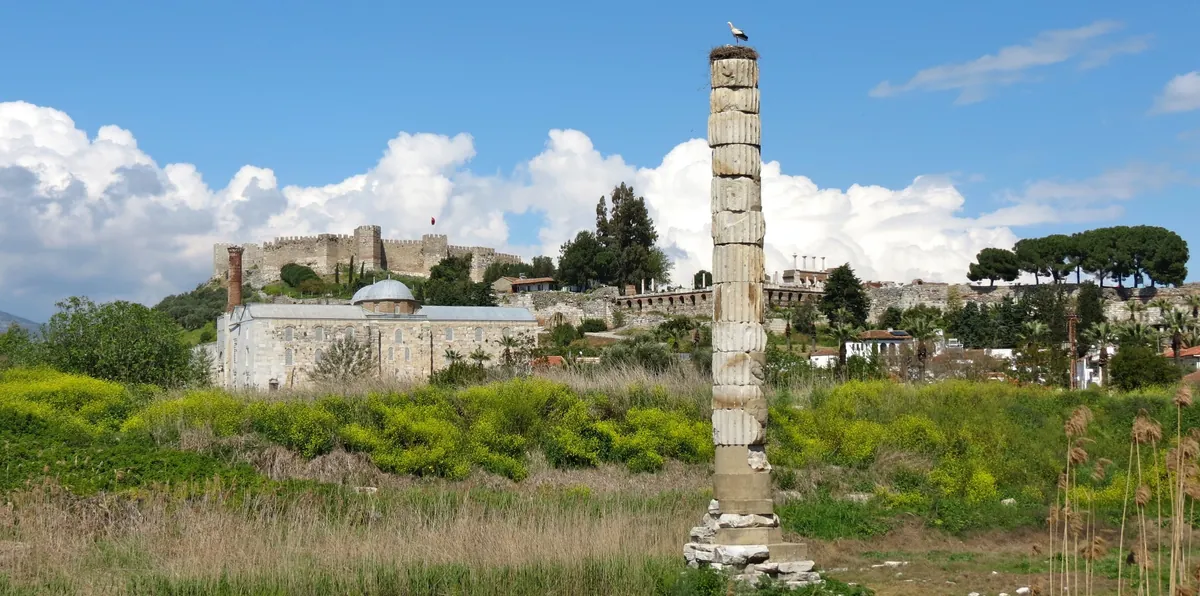
One column, re-erected from mismatched drums, stands in a green marsh; storks nest on its capital in spring. Around it are foundation blocks, a few wall fragments and, in wet winters, a shallow lake — the water table that once floated the marble platform now floods it. Look uphill and you see the whole story in one frame: the column of the pagan Wonder, the Isa Bey Mosque of 1375 built partly from its stones, and above them the Basilica of Saint John and Ayasuluk Fortress. Three faiths and three millennia in one photograph.
Where is the Temple of Artemis?
The Temple of Artemis is in Selcuk, Turkey, on the flat western edge of town, about a 10-minute walk from the town center and roughly 3 km by road from the lower gate of Ephesus. It sits just off the road between Selcuk and the ruins, below Ayasuluk Hill, at 37.9498° N, 27.3636° E.
It is not inside the ancient city you buy a ticket for, which surprises many visitors. When Lysimachus moved Ephesus to its present site around 290 BC, the goddess stayed where she was, and her temple ended up about 2 km outside the new city, linked to it by a sacred road that processions walked. Whether your map says Temple of Artemis, Temple of Diana or Artemision, it points to the same field.
- Selcuk town center: under a kilometer, about 10 minutes on foot.
- Ephesus Museum: about 400 m away as the crow flies.
- Isa Bey Mosque, Basilica of Saint John and Ayasuluk Fortress: all within about 750 m, on the hill behind the column.
- Lower gate of Ephesus: about 2.8 km by road, 5 to 10 minutes by car or about half an hour on foot along the road from Selcuk.
- Upper gate of Ephesus: about 4.5 km by road, around 10 minutes by car.
- Kusadasi cruise port: roughly 20 km, about 30 minutes by road. Izmir: about 80 km to the north.
Our Selcuk old town tour covers this whole corner of town: the column, the Ephesus Museum with the statues of Artemis, the Isa Bey Mosque and a panoramic stop at the Basilica of Saint John, with every ticket and lunch included. To see how the temple, the town and the two gates of the ruins fit together, open our Ephesus map.
Temple of Artemis entrance fee and opening
There is no ticket office and no gate: the site is free to visit at the time of writing (September 2026) and open in daylight hours. Allow 15 to 20 minutes. Regulations can change while archaeological work is under way, so we check before every tour.
Where to see the statues of Artemis
The temple's most famous residents live indoors. The Ephesus Museum in Selcuk displays the Great Artemis, 2.92 m tall, and the Beautiful Artemis, 1.74 m — Roman copies from the Prytaneion of Ephesus — crowned with a temple, belted with bees and hung with the oval pendants that scholars still argue about. Museum entry is €10 for foreign visitors (updated September 2026); on our all-inclusive Selcuk old town tour the ticket and a full guided visit are included.
Sources & further reading
- Wikipedia: Temple of Artemis — dimensions, dates and the Antipater and Jordanes quotations, cross-checked
- World History Encyclopedia: Temple of Artemis at Ephesus — Pliny's figures and the construction dates
- Ephesus Museum — official page (muze.gov.tr) — the Artemis statues and iconography
- UNESCO World Heritage Center: Ephesus — the Artemision within the listed property
See Temple of Artemis at Ephesus on these tours
Treasures of Ephesus Tour
3 hoursBest of Ephesus Tour
4–5 hoursArchaeological Ephesus Tour
5–6 hoursJewish Heritage Tour in Ephesus
5–6 hoursEphesus and Village Life Tour
6–7 hoursVillage Breakfast and Ephesus Tour
6–7 hoursEphesus Panoramic Tour
Ephesus Tour from Bodrum
Full day from BodrumSaints, Sultans & Artemis — Selcuk Old Town Tour
4–6 hoursKeep reading
See all attractions around EphesusHouse of the Virgin Mary: Entrance Fee, Dress Code & Visit
Fee, hours, dress code and what to expect at the hillside house where tradition holds Mary lived — visited by three popes and included on our private tours.
Basilica of Saint John
Justinian's great basilica over the tomb of Saint John the Evangelist, with the finest view over Selcuk thrown in.