

Two kilometers from Ephesus, on Ayasuluk Hill above modern Selcuk, stand the ruins of one of Byzantium's greatest churches — built over the spot where, from the earliest centuries, Christians venerated the tomb of Saint John the Evangelist.
The site's architectural biography mirrors Christianity's own rise. After John's death a simple wooden hut marked the grave. In the fourth century, as the faith emerged from persecution, a small chapel replaced it. And in the sixth century Emperor Justinian — builder of Hagia Sophia — raised a monumental cross-domed basilica whose six domes made it one of the largest churches of its age.
Walking the ruins
Today you enter through the Gate of Persecution and walk marble courtyards to the tomb, marked beneath the former altar. The baptistery beside the nave preserves its cruciform pool — one of the most evocative early-Christian baptisteries anywhere — and reconstructed columns hint at the scale Justinian intended. From the terrace, the view sweeps from Ayasuluk Fortress above you across the Temple of Artemis to the distant ruins of Ephesus: the whole story of the region in one panorama.
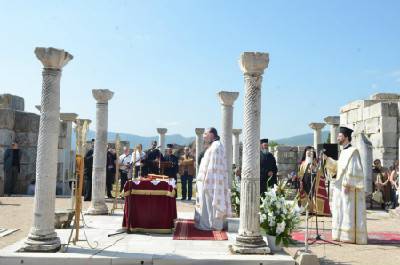
For pilgrims on our Biblical Ephesus Tour this is often the emotional summit of the day; for everyone else it is simply one of the loveliest, calmest ruins on the coast — golden stone, cypress trees and storks commuting between the fortress and the temple below.
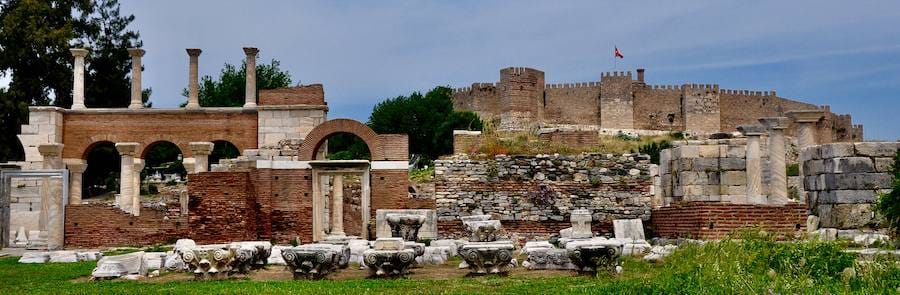
See Basilica of Saint John on these tours
Keep reading
See all attractions around EphesusTemple of Artemis at Ephesus — the Temple of Diana
One of the Seven Wonders of the Ancient World: what is left of the Temple of Artemis (Temple of Diana), why it made the list, and how to see it — and its statues — on a private tour.
Isa Bey Mosque
A jewel of Seljuk architecture from 1375, still an active mosque — and the calmest courtyard in Selcuk.