Ephesus is not just an ancient city in Turkey — it is one of the best-preserved Roman cities anywhere in the Mediterranean, and walking its marble streets remains the closest thing to time travel the ancient world offers.
Founded by the Greek prince Androclos in the 11th century BC, Ephesus grew wealthy in the middle of a rich valley as one of antiquity's busiest trading ports. Nearly everyone who mattered passed through: Apostle Paul preached here for three years, Saint John the Evangelist and — tradition holds — the Virgin Mary spent their last years nearby, and Cleopatra herself wintered here with Mark Antony.
How many people lived in Ephesus?
Nobody counted, so every figure is a modern estimate, and the method decides the answer. Older guidebooks give 200,000 to 250,000 — a figure that goes back to an 1886 estimate, to inscriptions read too generously (one said to record 40,000 citizens actually reads 1,040), and to multiplying the Grand Theater's seats by ten. Measure the lived-in city instead — about 224 of the 415 hectares inside the walls, since the rest was steep hillside and public space — and the number comes out to roughly 34,000 to 56,000 people. A 2017 model built on house counts gives about 72,000, and one scholar who allows much denser housing reaches 138,000 to 172,500. Whichever figure you use, Ephesus ranked among the five largest cities of the Roman world.
That theater seated about 25,000. Multiplying it by ten is a rule of thumb, not evidence: the seats also served visitors from the countryside and festival crowds, and a theater's size says more about a city's ambition than its head count.
What you will see
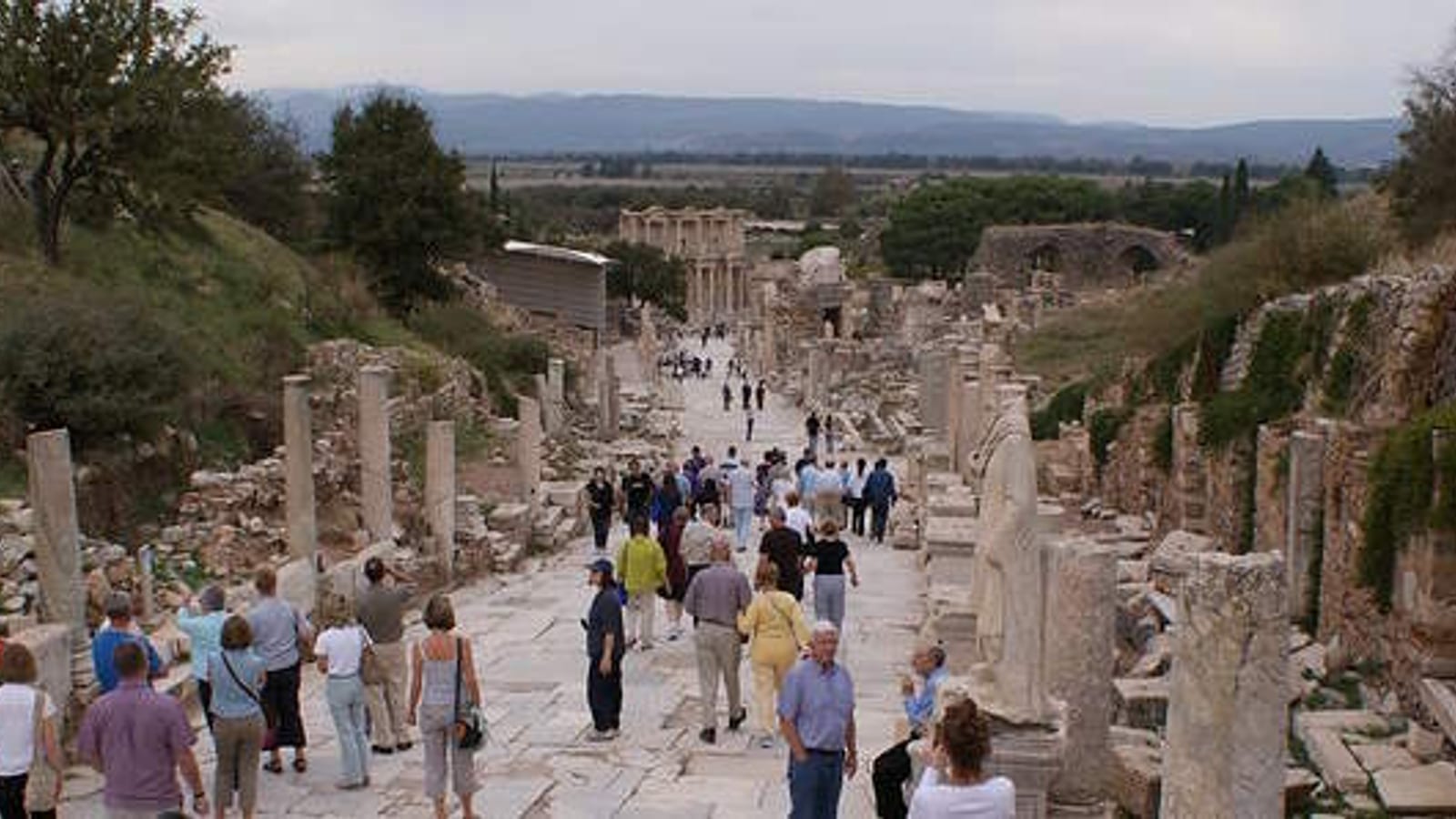
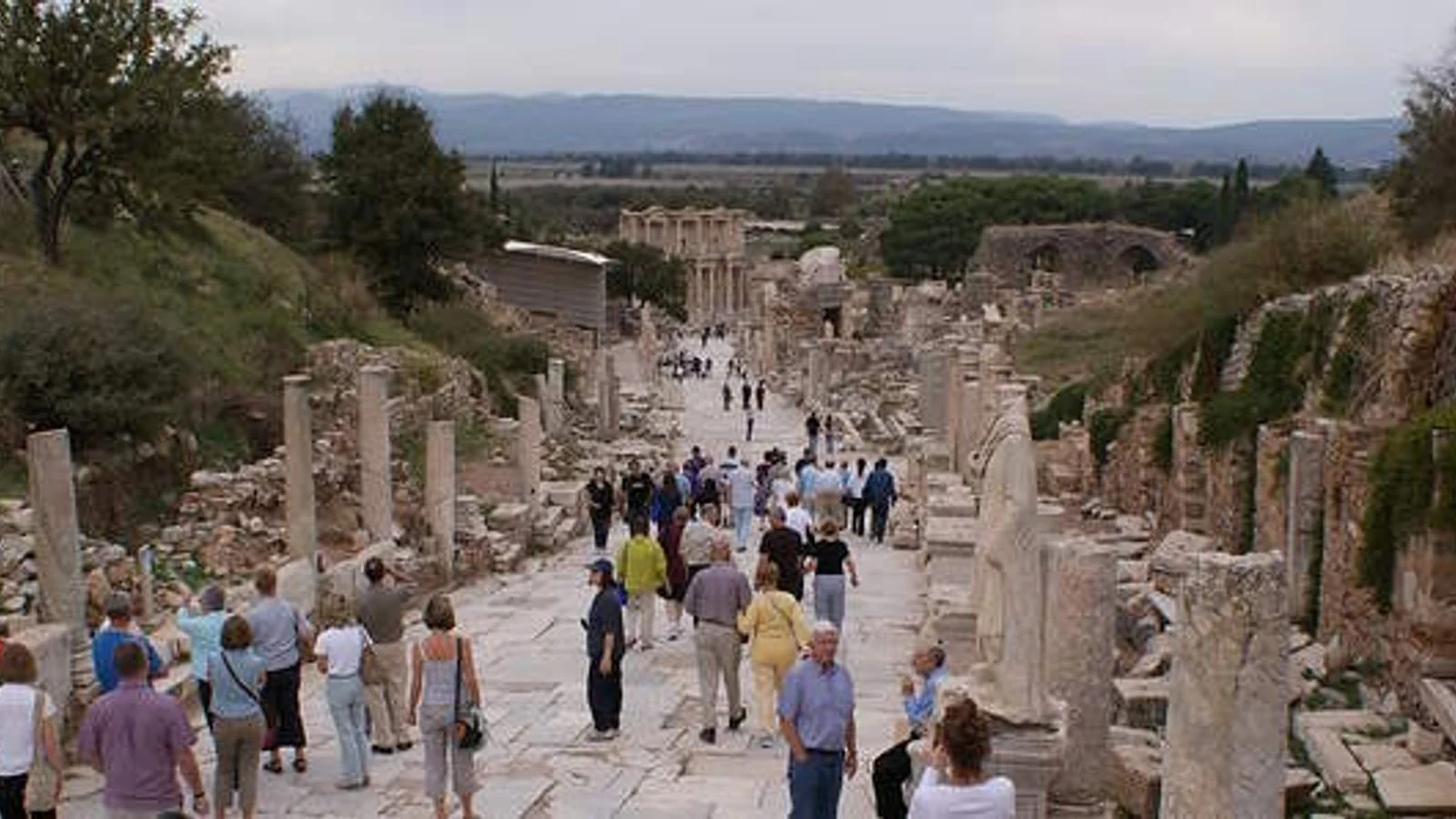
The Odeon, an intimate 1,500-seat hall used for concerts and city council meetings, opens the walk. The Temple of Hadrian, from the second century AD, carries some of the finest sculptural craftsmanship on the coast. Curetes Street runs downhill between countless columns and monuments on its marble pavement, through the Hercules Gate and past the Fountain of Trajan — where a surviving statue fragment shows the Romans depicted the world as a sphere at their emperor's feet.
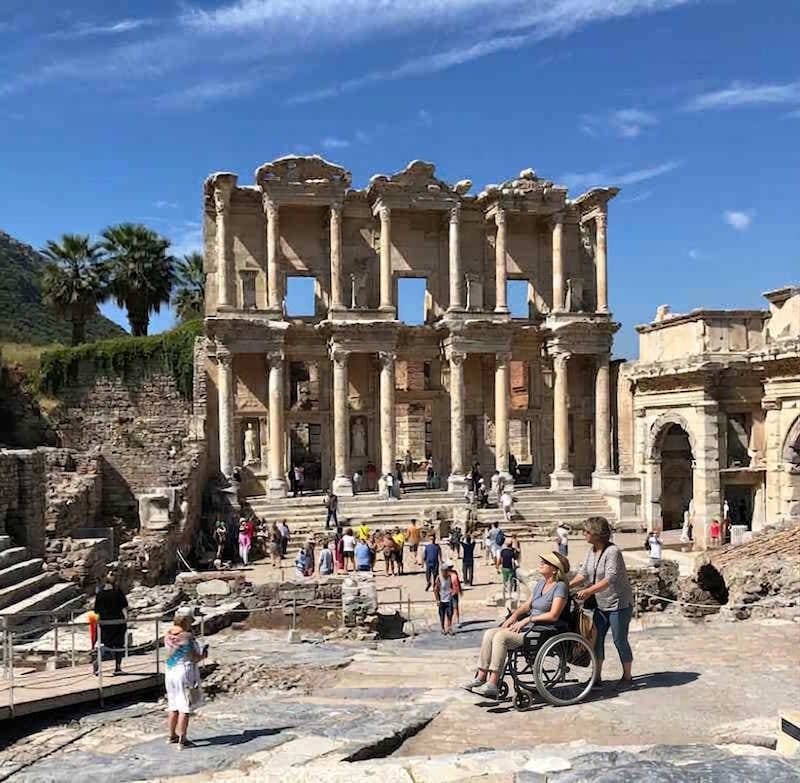
Then comes the moment every visitor remembers: the Library of Celsus rising two ornate stories at the street's end. Built in the name of Proconsul Tiberius Julius Celsus Polemaeanus, it housed some 12,000 scrolls and ranked as the third-greatest library of the ancient world after Alexandria and Pergamon. Beside it, the Commercial Agora traded goods from three continents; beyond it, the Grand Theater seated 25,000 spectators — and hosted the riot against Saint Paul described in Acts 19. Its acoustics still work; someone in your group will inevitably test them.

A local's advice
Only about ten percent of Ephesus has been excavated — the city rewards a guide who can raise the missing ninety percent in your imagination. Come early or late in the day (our article on the best time to visit has the full strategy); enter from the upper gate so the walk runs downhill; and do not skip the Terrace Houses, the frescoed Roman villas most visitors never see. Wear proper shoes: two-thousand-year-old marble is beautiful and slippery.
Sources & further reading
- UNESCO World Heritage Center: Ephesus — the official World Heritage listing
- Austrian Academy of Sciences — the institute excavating Ephesus since 1895
- Warden & Bagnall, "The Forty Thousand Citizens of Ephesus," Classical Philology 83 (1988) — the inscription reading behind the old population estimates
- Hanson & Ortman, Journal of Roman Archaeology 30 (2017) — the house-count model behind the ~72,000 estimate
See Ephesus Ancient City on these tours
Treasures of Ephesus Tour
3 hoursBest of Ephesus Tour
4–5 hoursFull Day Ephesus Tour
7–8 hoursArchaeological Ephesus Tour
5–6 hoursBiblical Ephesus Tour
5–6 hoursJewish Heritage Tour in Ephesus
5–6 hoursEphesus and Village Life Tour
6–7 hoursEphesus Tour for Children
4–6 hours (flexible)Ephesus Tour for Teens
6–7 hours (flexible)Ephesus Tour for Elder Travelers
4–5 hours (relaxed)Village Breakfast and Ephesus Tour
6–7 hoursEphesus and Shopping Tour
6–7 hoursEphesus and Pergamon Tour
10–11 hoursEphesus and Pamukkale Tour
11–12 hoursEphesus, Didyma and Miletus Tour
9–10 hoursKusadasi to Ephesus Shore Excursion
4–6 hours (fits your port time)Izmir to Ephesus Private Tour
8–9 hours door to doorIstanbul to Ephesus Day Trip
Full day (first to last flight)Ephesus Tour from Bodrum
Full day from BodrumEphesus Tour from Samos — Ferry Day Trip via Kusadasi
About 7 hours ashore, between the morning and evening ferriesKeep reading
See all attractions around EphesusGreat Theater of Ephesus
The 25,000-seat giant where Saint Paul faced a screaming crowd — and where the acoustics still carry a whisper to the top row.
Terrace Houses in Ephesus
Seven Roman villas under one protective roof, their frescoes and mosaics astonishingly intact. The sight most visitors wrongly skip.