
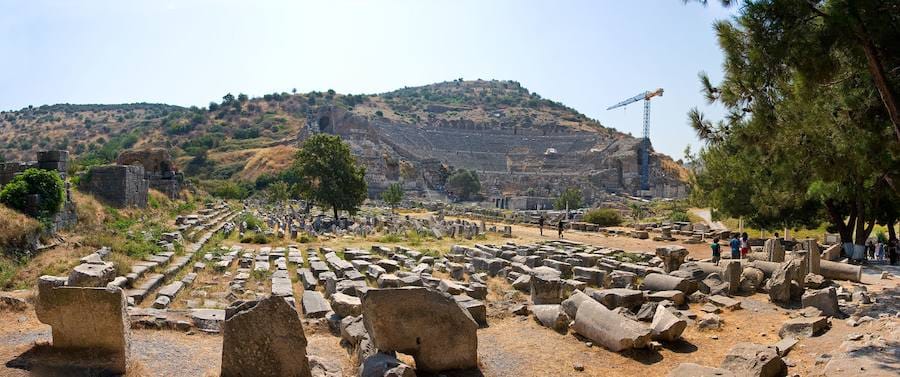
Stand in the center of the orchestra, say something quietly, and watch your family react thirty meters up in the top rows. Everyone does it. Everyone grins. The Great Theater of Ephesus is the largest ancient theater in Anatolia, and after two thousand years its acoustics still need no microphone.
The Greeks began it in the Hellenistic era, carving the seating into the slope of Panayır Hill; the Romans then spent most of the first and second centuries AD enlarging it to a colossal 25,000 seats. Multiply those seats by ten, the old rule of thumb, and you get the quarter of a million Ephesians still quoted in many books, a figure that goes back to an 1886 estimate. The two most recent systematic studies, which measure the city's inhabited area instead, put Roman Ephesus at roughly 34,000 to 72,000 people, so this one building could seat a third or more of the whole city at once.
The afternoon it made the Bible
In the mid-50s AD, a silversmith named Demetrius realized that Paul's preaching was ruining the market for silver shrines of Artemis, and whipped his fellow craftsmen into fury. The mob dragged Paul's companions into this very theater and chanted "Great is Artemis of the Ephesians!" for about two hours — the whole scene is written down in Acts chapter 19, and you can read it standing exactly where it happened. It remains, for many of our guests, the single most powerful moment of their trip.
From drama to gladiators to rock stars
Tastes changed as the empire aged. In the second and third centuries a protective wall was raised around the orchestra so the theater could host gladiator fights and beast hunts — the front-row seats became the ancient equivalent of splash-zone seating. The gladiators of Ephesus are no legend, by the way; their graveyard was found just outside the city, and their bones tell astonishing stories.
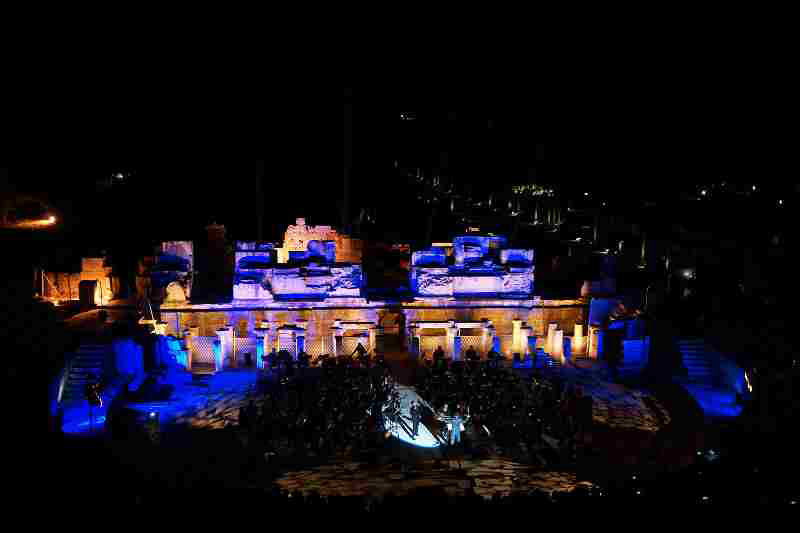
The modern era simply picked up the tradition. Elton John sang here on 17 July 2001, and Sting, Ray Charles, Joan Baez and José Carreras all played the festival years; the Berlin Philharmonic reopened the theater in 2012 and it still hosts festival concerts on summer evenings. If your travel dates line up with one, do not hesitate — hearing music in a full ancient theater rearranges something in you.
A practical note from the guides: the climb to the upper rows is steep and the stone is worn smooth, so good shoes matter. The view from the top — straight down Harbor Street toward the vanished sea — is the best single panorama in Ephesus.
Sources & further reading
- UNESCO World Heritage Center: Ephesus — the official World Heritage listing
- Austrian Academy of Sciences — excavation and conservation of the theater
- Encyclopaedia Britannica: Ephesus — the theater in the city's history