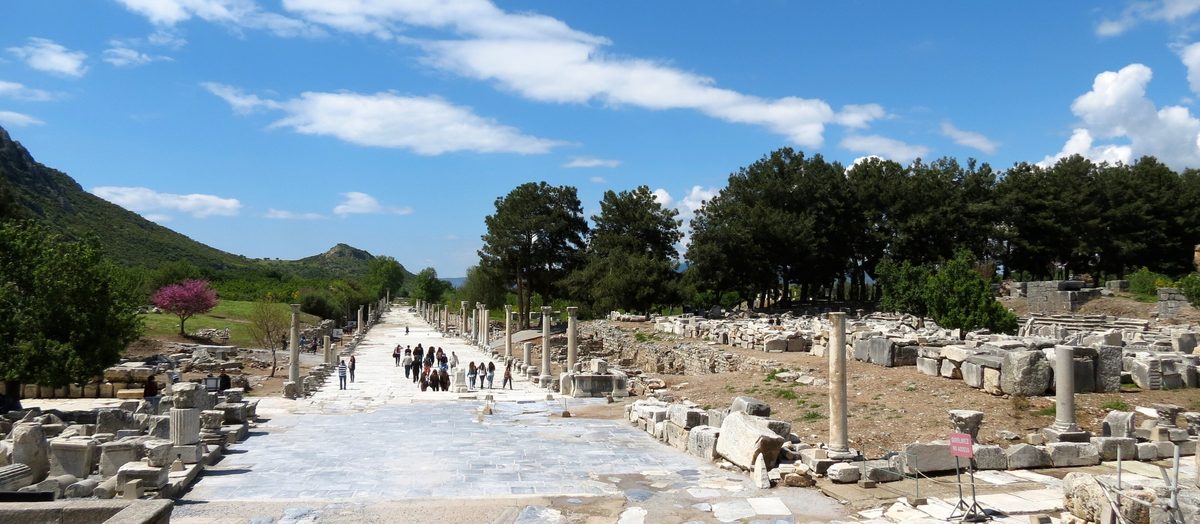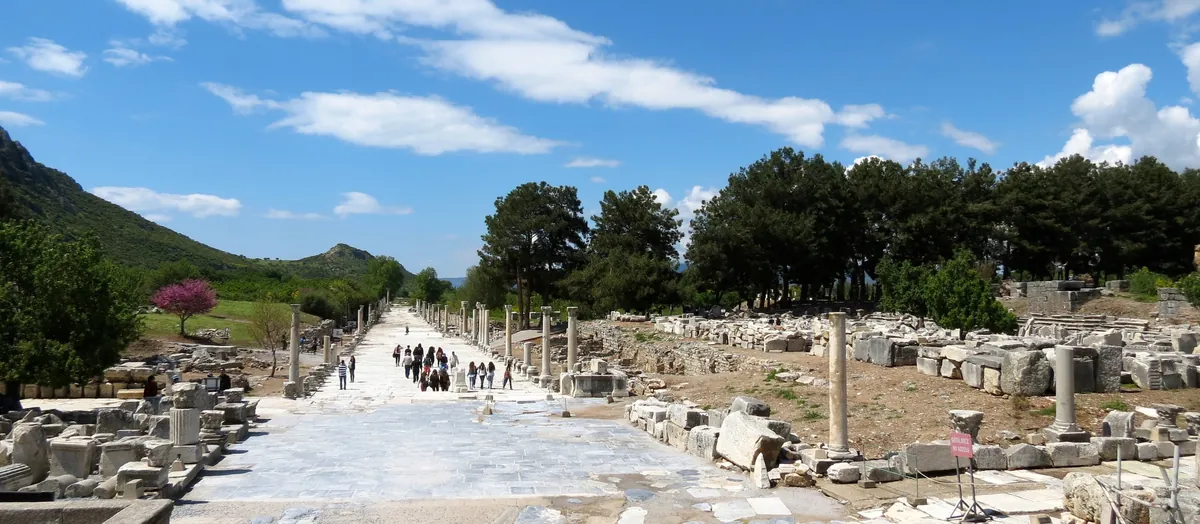
Temples explain what Ephesus believed; the agora explains how Ephesus could afford it. Through the Gate of Mazaeus and Mithridates beside the library opens a square vast enough to lose a football pitch in — the Commercial Agora, the trading floor of the Roman East.
One hundred and ten meters on each side, ringed by double colonnades of shops two rows deep, this was where the wealth of three continents changed hands: wine and olive oil, Anatolian wool, Egyptian grain, eastern silk and spices, glass, slaves, silver. When Paul's preaching threatened the silver-shrine business, the riot that filled the Great Theater started with merchants from this square — the market defending its margins, as markets do.
Harbor Street: the red carpet to the sea
From the theater's foot runs the grandest street in the city: 530 meters of marble, eleven meters wide, flanked by colonnaded walkways — Harbor Street, or the Arcadiane after the emperor Arcadius who rebuilt it splendidly around AD 400. This was the first thing arriving sailors, merchants and emperors saw of Ephesus: a dead-straight triumphal approach from the docks to the city center. Inscriptions record the almost unbelievable amenity that made it famous — the street was lit at night by oil lamps, a luxury shared in antiquity by only a handful of cities on earth.
Walk it toward the sunset and you are walking toward a sea that is no longer there. The harbor at its far end silted into marsh centuries ago; the coast now lies kilometers away at Pamucak. The street that welcomed the world ends today in reeds and frog-song — the most poetic dead end in archaeology, and the exact spot where our guides explain how the mud finally beat the greatest port in Asia.
The agora is easy to pass with only a glance on the way from the library to the theater. Ask for ten unhurried minutes here instead: stand mid-square, spin slowly, and picture the noise. Every column around you was paid for by a deal shouted across this space.
Sources & further reading
- UNESCO World Heritage Center: Ephesus — the official World Heritage listing
- Austrian Academy of Sciences — research on the harbor and Arcadiane
- Encyclopaedia Britannica: Ephesus — trade and economy of the city
Keep reading
See all attractions around EphesusHercules Gate
The hero in his lion skin guards the top of Curetes Street — a gate designed to keep carts out of downtown, two millennia before car-free city centers.
Church of Mary (Council Church)
The first church ever dedicated to the Virgin Mary — and the hall where the Council of Ephesus proclaimed her Theotokos in AD 431.