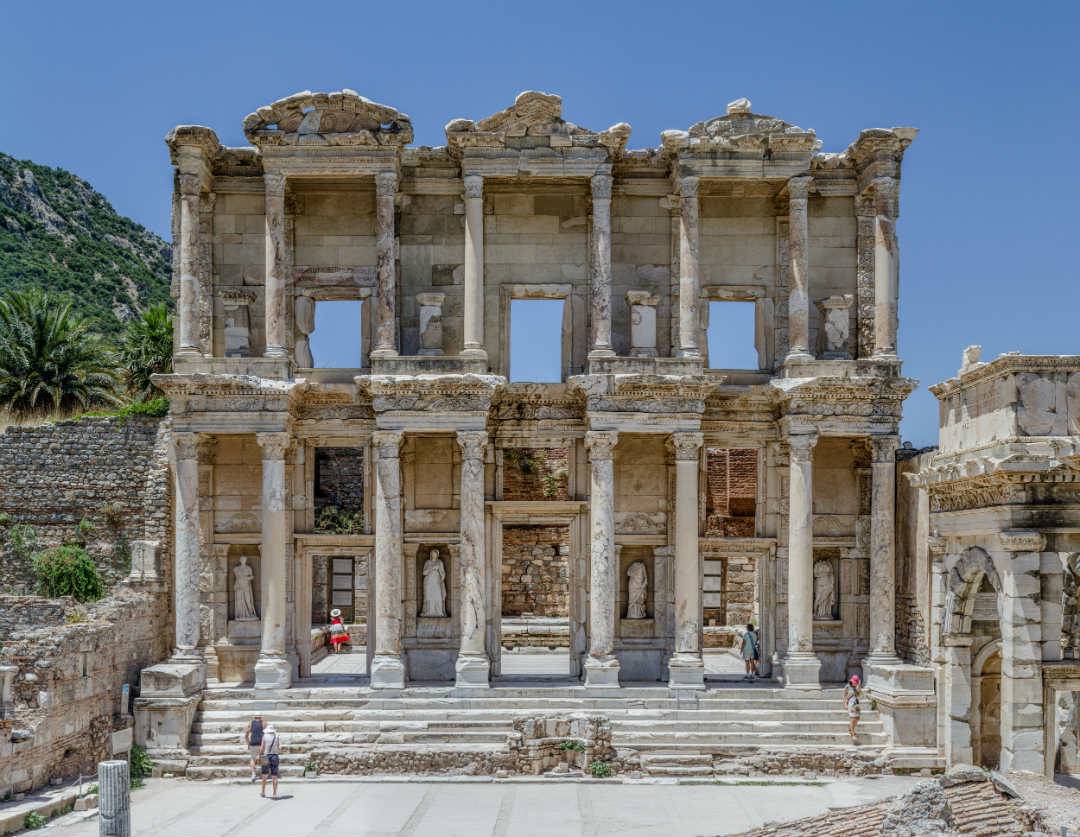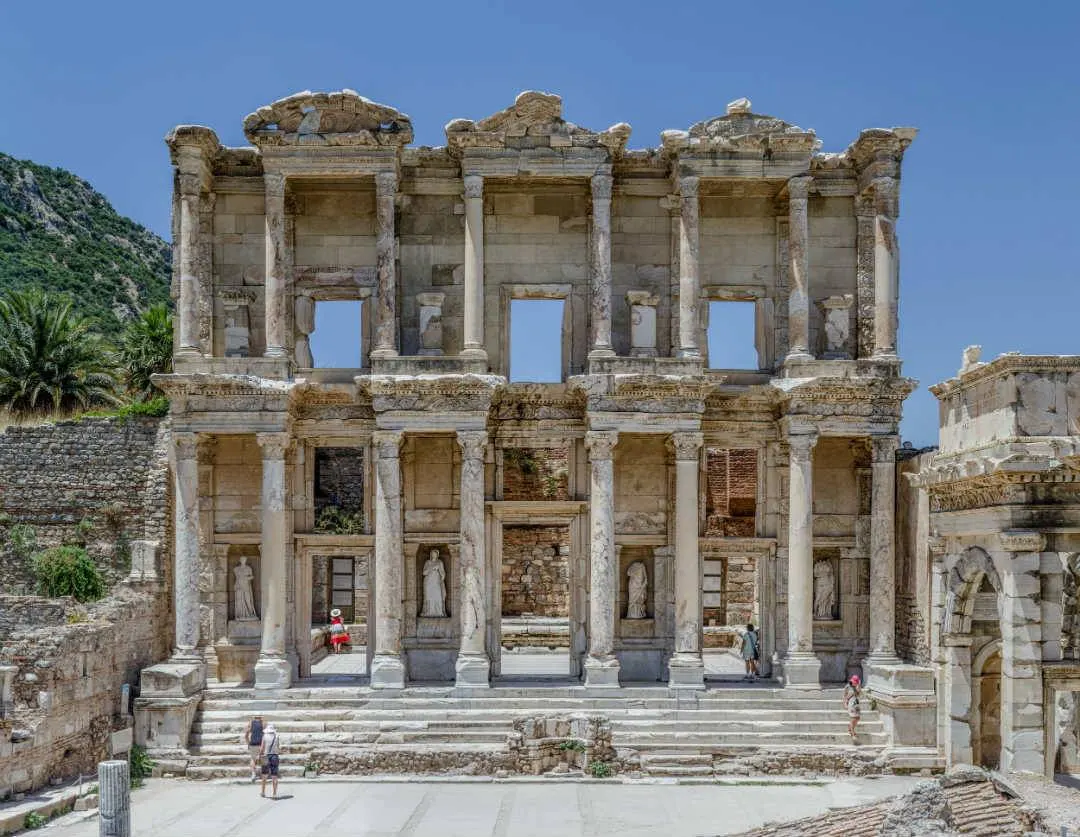
Turn right at the Library of Celsus and you are on Marble Street — the broad, gleaming avenue that runs beneath the Great Theatre. This was a stretch of the sacred way, the processional route that circled out to the Temple of Artemis; on festival days the goddess's statues rode along it in ceremony while the whole city watched.
The street earns its plain name honestly: it is paved edge to edge in thick marble slabs, raised on a platform above the sewer line. Look closely at the surface and the Roman traffic report appears — deep parallel ruts worn by centuries of cart wheels, and beneath the raised colonnade, the polished path where pedestrians kept out of the vehicles' way. Two thousand years later, the lane markings still work.
The most famous footprint in Turkey
Halfway along, every guide stops at one particular slab. Carved into the marble: a left footprint, a woman's face, a heart, and a purse. Generations of visitors have heard the interpretation — if your foot is bigger than the print (an adult's), and you have money, follow the direction of the toes to the house across the agora where a lady is waiting. It is very likely the oldest surviving advertisement in the world, and it was certainly not advertising a bookshop. The Romans were many things; subtle was not one of them.
A gate built on gratitude
At the street's south end, beside the library, rises the triple-arched Gate of Mazaeus and Mithridates. Its story is the best in Ephesus: Mazaeus and Mithridates were slaves in the household of the Emperor Augustus, were freed, grew wealthy, and built this monumental gate in 4–3 BC as a thank-you to the emperor and his family — their patrons' names spelled out in letters that were once inlaid bronze. From property to philanthropists, in one lifetime; their gate has now outlasted the empire that freed them.
One more detail we cannot resist: a warning carved near the gate promises the wrath of Hekate — a goddess you did not want angry — upon anyone who urinates there. Public order, ancient style. It apparently worked; the gate is immaculate.
Sources & further reading
- UNESCO World Heritage Centre: Ephesus — the official World Heritage listing
- Austrian Academy of Sciences — excavation of the street and gate
- Perseus Digital Library, Tufts University — ancient sources on Ephesus