
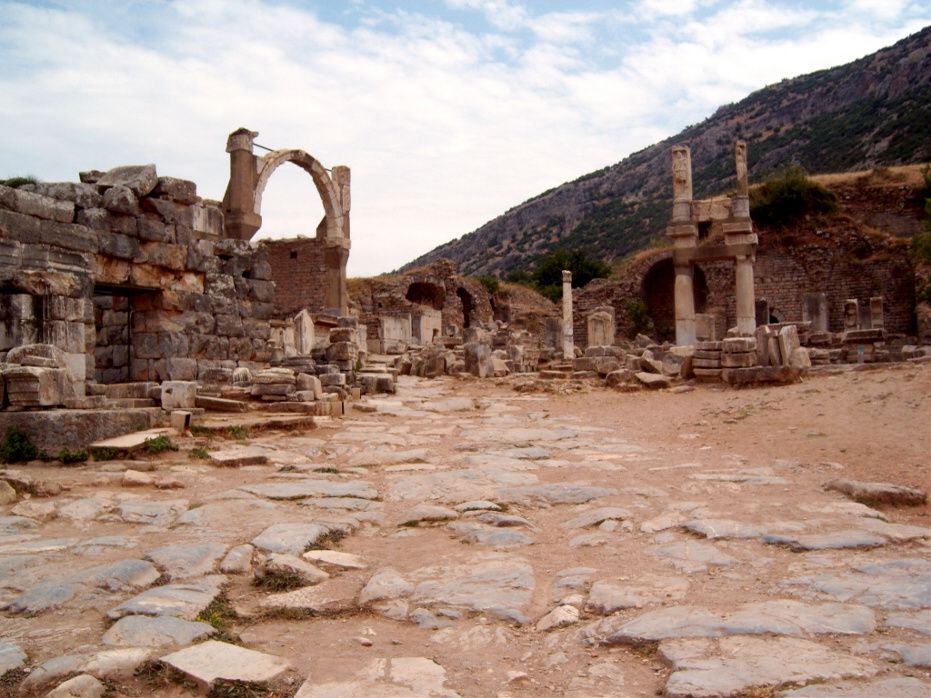
Every city has a story it tells reluctantly. In Ephesus, it starts at a wide terrace above Domitian Square, where the city's first temple to a living emperor once stood — and where that emperor's memory was later scraped away with official thoroughness.
Winning the right to build an imperial cult temple — the coveted title of neokoros, "temple warden" — was the first-century equivalent of landing the Olympics. Around AD 86, Ephesus finally received it and raised a temple to the reigning emperor Domitian on an enormous artificial terrace, complete with a colossal cult statue several times life size. The head and a forearm survive, and the head alone is the size of a washing machine; the complete figure would have towered over worshippers like a marble giant.
Damnatio memoriae: the ancient delete key
The problem was Domitian himself — paranoid, autocratic, and increasingly murderous toward his own aristocracy. In AD 96 his own household staff assassinated him, and the Senate passed something extraordinary: damnatio memoriae, the condemnation of memory. His statues were toppled empire-wide, his name chiseled out of inscriptions, his coins melted. Ephesus, faced with a brand-new temple to an officially non-existent person, found an elegant exit — the temple was quietly rededicated to Domitian's respectable father, the deified Vespasian, and everyone agreed to move on. The city kept its precious neokoros title; the emperor lost eternity. You can still find inscriptions in Ephesus where his erased name survives only as a smooth rectangular scar.
Worth finding nearby
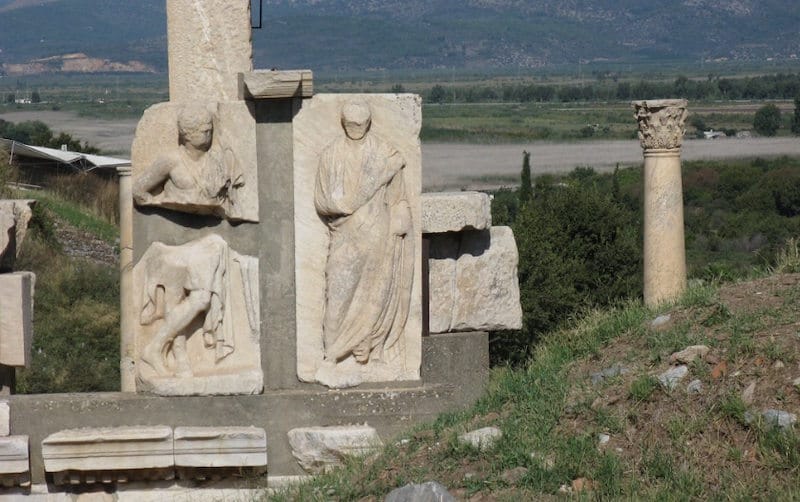
The square below the terrace collects several treasures visitors stride past. The Memmius Monument honors the grandson of the Roman dictator Sulla — a pointed reminder, raised in the first century BC, of who had crushed the city's anti-Roman uprising a generation earlier. And resting on the ground beside it lies the famous relief of Nike, goddess of victory, wings spread and robes streaming — locals delight in pointing out that her silhouette matches a certain sportswear logo. The goddess of victory, still doing brand work after two millennia.
From here the Hercules Gate funnels you onto Curetes Street — but give this quieter terrace ten minutes first. The story of the emperor who was erased is one our guests quote back to us at dinner.

Sources & further reading
- UNESCO World Heritage Center: Ephesus — the official World Heritage listing
- Encyclopaedia Britannica: Domitian — the emperor and his damnatio memoriae
- Austrian Academy of Sciences — excavation of the temple terrace
Keep reading
See all attractions around EphesusMarble Street & the Gate of Mazaeus and Mithridates
The grand marble avenue between the Library and the Theater — wheel ruts, the carved footprint everyone calls an advertisement, and a gate built by two grateful freedmen.
Fountain of Trajan
A monumental fountain with the emperor's foot on the globe — proof in marble that the Romans knew the earth was round.