

Enter Ephesus from the upper gate and the first great monument to greet you is a perfect little semicircle of marble seats. Most visitors assume it is "the theater" and start photographing. It is better than that: you are looking at the room where Ephesus was governed.
The Odeon was built around AD 150, a gift to the city from Publius Vedius Antoninus and his wife Flavia Papiana — one of those wealthy couples who competed to out-donate each other in public monuments (the habit built half of Ephesus). It held about 1,500 people under a timber roof, which made it the city's all-weather venue: the roof is long gone, but you can still see that the seating rises steeper than an open-air theater would dare, precisely because there was a ceiling to consider.
Parliament by day, concert hall by night
Officially this building was the bouleuterion — the meeting hall of the boule, the city council of some 300 members that ran day-to-day Ephesus. Zoning disputes, festival budgets, embassies to Rome: decisions affecting one of the five largest cities of the empire were argued out in a hall smaller than a modern cinema. When the councillors went home, the same stage hosted music, poetry competitions and recitals; the word "odeon" comes from the Greek for song. Day job and night job, one building — the Ephesians were practical people.
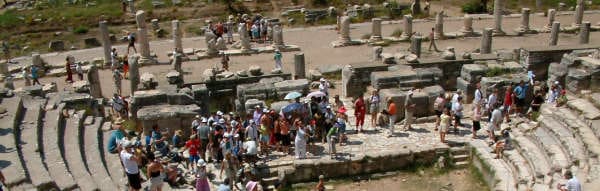
Beside the Odeon stretches the State Agora, the formal government square, with the ruins of the Prytaneion nearby — the city hall that housed the sacred eternal flame and where the two great Artemis statues now in the museum were found buried, hidden with care by the last pagans of Ephesus. From here, the marble road leads on past the Temple of Domitian to the Hercules Gate, where the famous downhill walk begins.
Guides like this corner of the city early in the morning, when the tour flow has not yet arrived and swallows own the acoustics. Sit a moment on the marble benches — you are occupying, quite literally, a seat of power.
Sources & further reading
- UNESCO World Heritage Center: Ephesus — the official World Heritage listing
- Austrian Academy of Sciences — excavations of the upper city
Keep reading
See all attractions around EphesusTemple of Hadrian
The jewel-box temple on Curetes Street — Tyche on the arch, Medusa over the door, and the legend of the city's founding in its friezes.
Marble Street & the Gate of Mazaeus and Mithridates
The grand marble avenue between the Library and the Theater — wheel ruts, the carved footprint everyone calls an advertisement, and a gate built by two grateful freedmen.
