
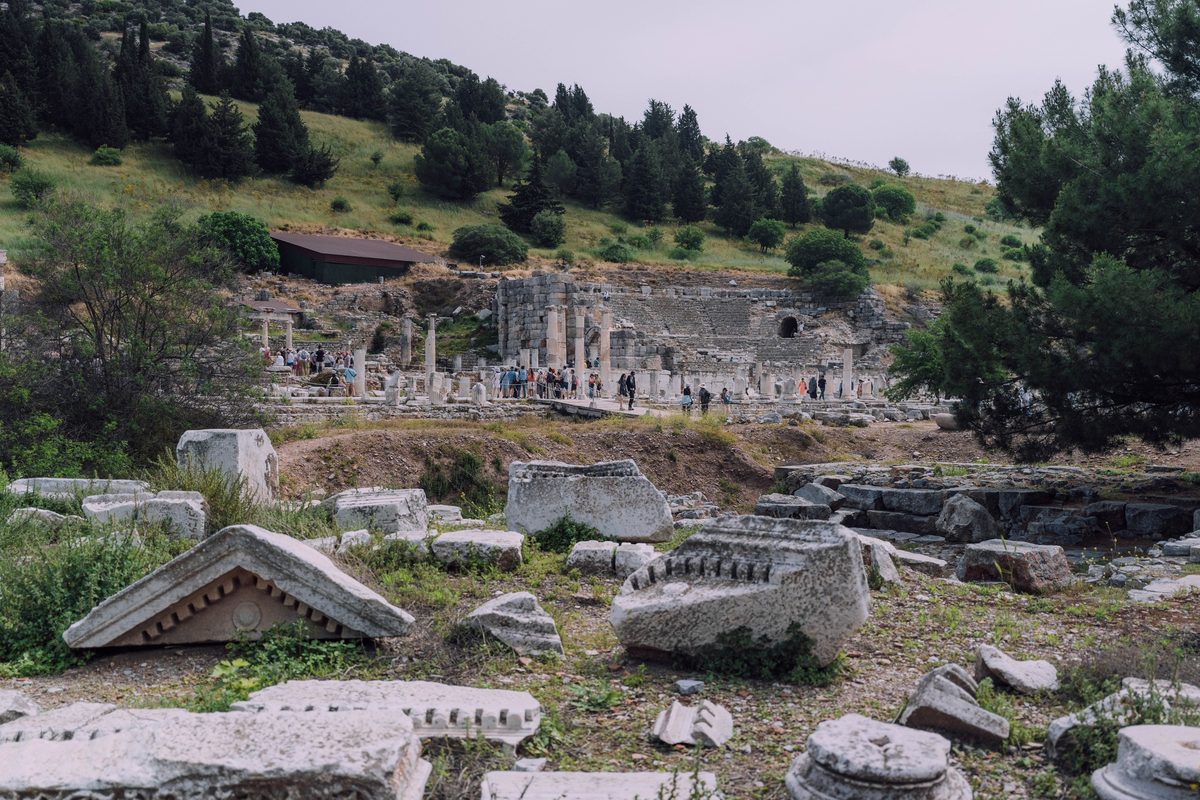
The Fountain of Gaius Laecanius Bassus is the ruined Roman water palace at the upper end of Ephesus, built about AD 80 and named for the proconsul of Asia. Its Greek name, hydrekdocheion, means a water distribution house: the aqueducts arrived here first, and the rest of the city drank downstream of it.
Most visitors walk straight past. It sits at the top of the site near the corner of the State Agora, and what survives is low: foundations, a wide shallow basin, carved blocks laid out by the excavators. Then someone tells you that basin held about 105 square meters of water behind a front three stories tall, and the ruin reorganizes itself in your head.
What a hydrekdocheion actually was
The Romans had a perfectly good word for an ornamental fountain, nymphaeum, and Ephesus has famous ones. This building is not called that in its own inscription. It is called a hydrekdocheion, a water-receiving house, and the difference is practical rather than poetic. Water came down from the hills by aqueduct, arrived here, and went out again through pipes to the fountains, baths and public basins deeper in the city. The marble front was the advertisement. The reservoir behind it was the point.
The nickname on the information panel at the site says the same thing more cheerfully. The panel, put up by the Ministry of Culture and Tourism with the Austrian Archaeological Institute that excavates Ephesus, calls it the Water Palace: Su Sarayi in Turkish, Wasserschloss in German.
Who was Gaius Laecanius Bassus?
He was the Roman proconsul of Asia, governor of the province whose capital was Ephesus, around AD 80. These were the Flavian years, when the city was rebuilding its civic center on a grand scale. The panel at the site says the fountain was donated by him. Historians argue about how literally to read that: whether the proconsul paid out of his own pocket, in the ordinary manner of Roman public giving, or whether he approved it, found the money and saw it built because that was a governor's job. The wording of the inscription can carry either sense. What is not in doubt is whose name the city attached to its water.
That is worth a moment. Ephesus honored a man for plumbing. In a city that baked through a long Aegean summer, with a population big enough to make thirst a political problem, delivering water reliably was one of the most visible things a governor could do.
What it looked like
The basin was rectangular and large, about 105 square meters of open water. Three of its sides were framed by facades of two and three stories, built up in aediculae, the little columned niches that Roman architects stacked like a stage set, each one holding a statue. The fourth side carried a draw basin at the front, where people actually took the water away.
The sculpture was water-themed and, for civic architecture, rather playful. A Triton is among the figures recorded on the site panel, and river gods are reported among the statuary. Put the colored marble, the columns and the statues back, add water moving through all of it in the afternoon light, and you have the effect the builders wanted. Roman architects understood that falling water is the one decoration that never stops performing.

The building that taught Ephesus how to build fountains
If the layout sounds familiar, you will meet it again further down the hill. A deep basin with a tall columned front rising behind it, like the back wall of a theater, is the pattern the later Ephesian fountains follow, the celebrated Fountain of Trajan on Curetes Street among them. The Water Palace came first, by a generation or so.
What happened to it
The same things that undid the rest of Ephesus undid this. Earthquakes shook the upper city repeatedly in late antiquity, the long aqueducts that fed it grew harder to keep in repair, and the civic center around it lost its purpose as the city shrank and its people moved toward the hill at Selcuk. Late in its working life the water lines in this quarter were re-plumbed toward local cisterns, which is what a shrinking city does. It keeps the water and lets the architecture go. The long version of that story is on our page about why Ephesus was abandoned.
How to find it
Come in by the Upper Gate, as most of our tours do, and it is a couple of minutes' walk. The fountain is at the upper, civic end of the site where two main streets crossed, beside the State Agora, with the Temple of Domitian, the Memmius Monument and the Hercules Gate all within about a hundred and fifty meters. Almost everyone on that path is already walking downhill toward the Library of Celsus and does not stop here. Stop here.
Sources & further reading
- UNESCO World Heritage Center: Ephesus — the official World Heritage listing
- Text of the Hydrekdocheion information panel at Ephesus — erected by the Ministry of Culture and Tourism and the Austrian Archaeological Institute
Keep reading
See all attractions around EphesusFountain of Trajan
A monumental fountain with the emperor's foot on the globe — proof in marble that the Romans knew the earth was round.
Baths of Scholastica & the Public Latrines
Three floors of Roman bathing culture and the sociable marble latrines beside them — the corner of Ephesus everyone remembers.