
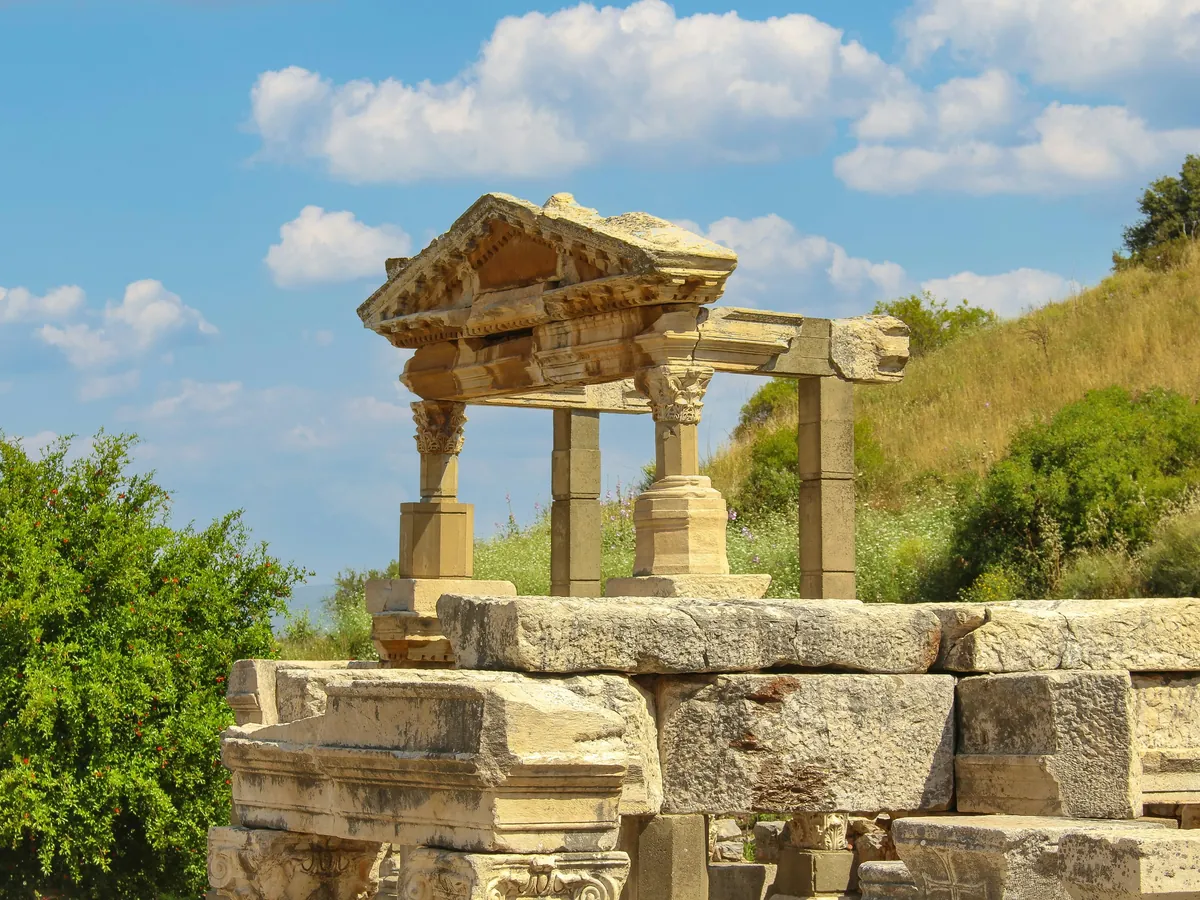
On the right side of Curetes Street, a shallow marble pool marks what was once one of the showiest buildings in the city: the Fountain of Trajan, a twelve-meter, two-story facade of columns and statues built around a cascade of fresh aqueduct water.
In the central niche stood a colossal statue of the emperor Trajan — and though the statue is mostly gone, its most eloquent piece survives on site: one enormous bare foot, planted on a sphere. The inscription and the pose said the same thing: the world lies beneath the emperor. Guides adore this fragment for a second reason, and we tell it on every tour — that sphere is the Romans casually informing you they knew the earth was round, eighteen centuries before the argument supposedly ended.
What a nymphaeum was for
Ephesus did not invent this shape here. A generation earlier, at the top of the city, the Fountain of Gaius Laecanius Bassus had already put a deep basin in front of a tall columned front, and every grand fountain built afterwards, this one included, follows that template.
Monumental fountains — nymphaea — were the ancient city's water infrastructure wearing its Sunday best. Aqueducts delivered mountain water to these grand distribution points, citizens filled vessels at the basins, and the sculptural program overhead reminded everyone who paid for civilization. This one was dedicated between AD 102 and 114 by a wealthy Ephesian in honor of Trajan and of Artemis — covering the political and the divine bases in one gesture, as sensible donors did.
Statues of the imperial family, Dionysus and a resting satyr filled the niches; most now live in the Ephesus Museum, where you can meet them face to face at eye level — a strange intimacy the original visitors, craning their necks from street level, never got.
The fountain works best as a lesson in reading ruins. What survives on the street looks modest: a pool, some columns, that magnificent foot. But stand at the pool's edge, raise the two stories in your mind, add the splash and glitter of falling water on a 35-degree Ephesian afternoon — and you understand why ancient writers described fountains before they described temples. Water in this climate was the true luxury; marble was just its frame.
Sources & further reading
- UNESCO World Heritage Center: Ephesus — the official World Heritage listing
- Encyclopaedia Britannica: Trajan — the emperor honored by the fountain
Keep reading
See all attractions around EphesusFountain of Gaius Laecanius Bassus
The Water Palace at the top of Ephesus: a working reservoir dressed as a monument, built about AD 80 and copied by every fountain that came after it.
Baths of Scholastica & the Public Latrines
Three floors of Roman bathing culture and the sociable marble latrines beside them — the corner of Ephesus everyone remembers.
