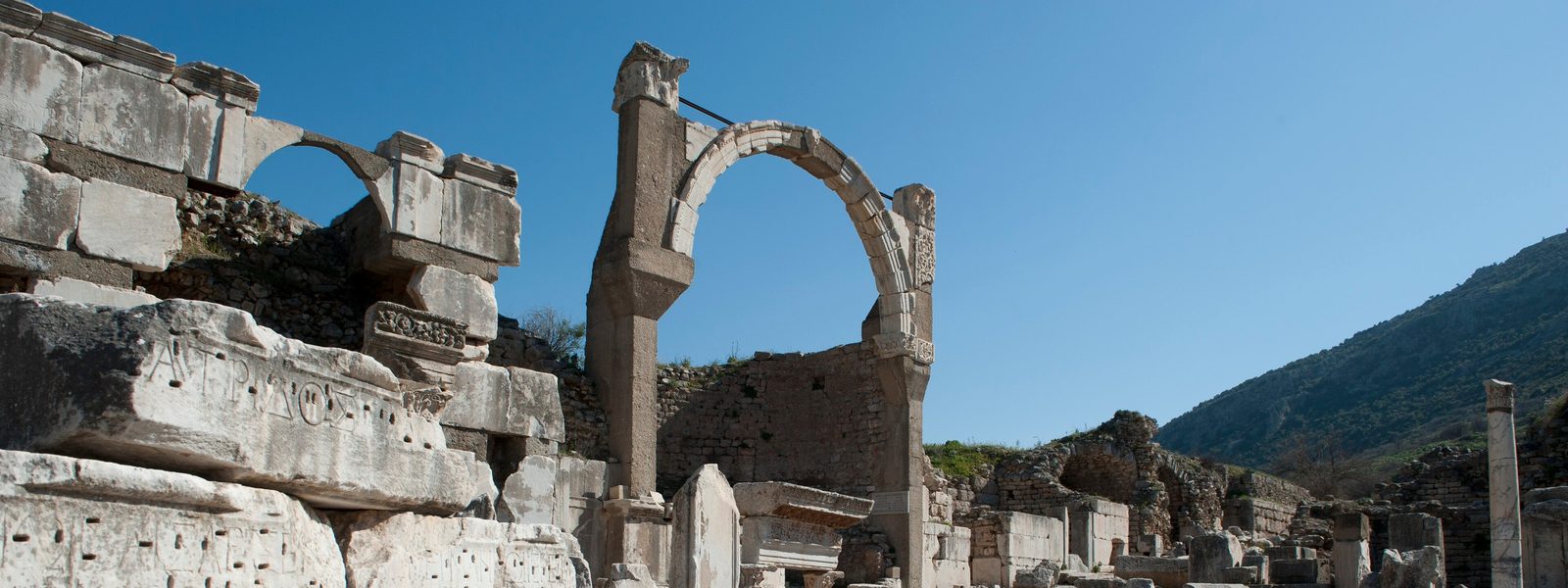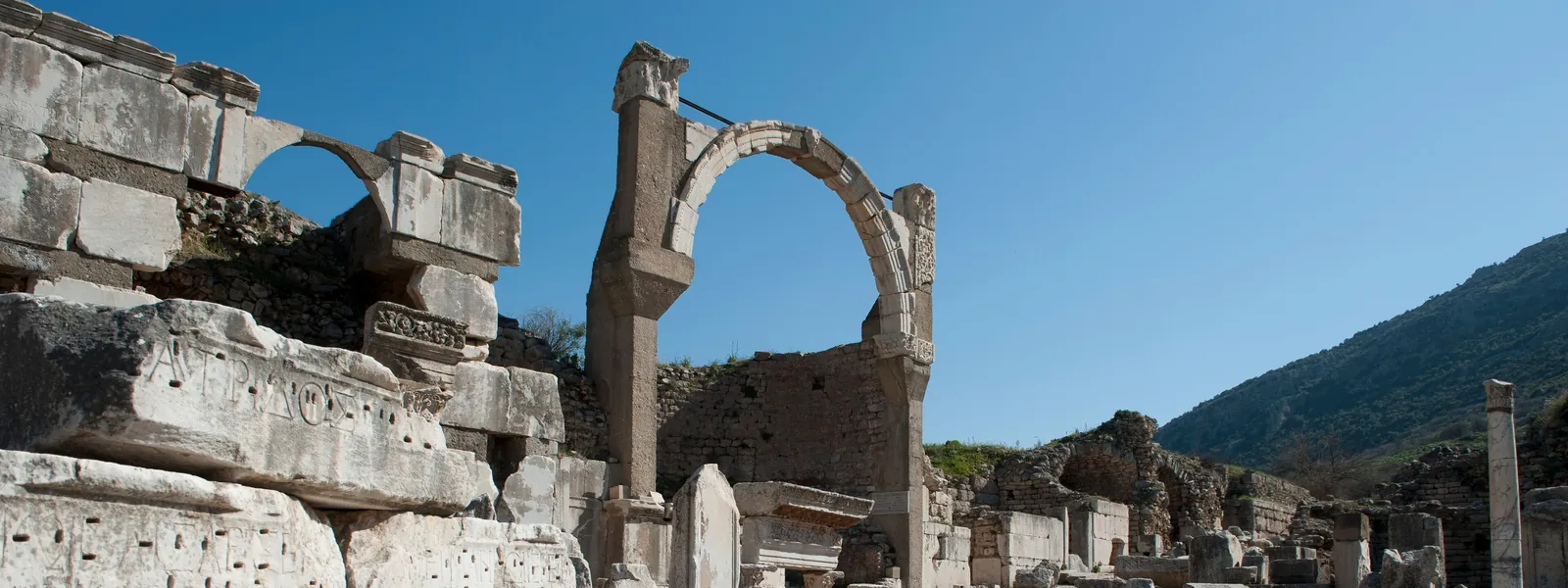
The Pollio Fountain in Ephesus is the arched fountain on Domitian Square in the upper city, and its name covers two buildings. Beside the arch stands the Pollio Monument, a memorial to Gaius Sextilius Pollio from the first half of the 1st century AD. The Fountain of Domitian was built against it in AD 92/93, and its apse held a statue group of Odysseus and the Cyclops Polyphemus.
Who built the Pollio Fountain, and when?
Both dates are the ones on the official information panel at the monument, which names the place the Pollio Monument and Fountain of Domitian. Scholars still debate whether the memorial went up under Augustus or a little later under Tiberius, and the panel's "first half of the 1st century AD" covers both. A date of AD 97 is widely repeated, sometimes with Pollio named as the builder of the fountain. It does not match the panel. Pollio's own building projects belong to the years around AD 4 to 14, roughly eighty years before the fountain.
Who was Gaius Sextilius Pollio?
Gaius Sextilius Pollio was a Roman citizen living in Ephesus, from a family that scholars believe came from Italy, and one of the city's great benefactors under Augustus and Tiberius. His inscriptions name him with his wife, Ofillia Bassa, and with Gaius Ofillius Proculus, who appears in them as Pollio's son. Proculus carried the family name Ofillius, not Sextilius, though, and the panel at the site calls him Pollio's stepson.
Two of his gifts shaped the upper city. On the north side of the State Agora, next to the Odeon, he paid for the Basilica Stoa, a long columned hall dedicated in AD 11, in Latin and Greek, to Artemis of Ephesus, Augustus, Tiberius and the city. Between AD 4 and 14 he and Proculus oversaw a new aqueduct that Augustus and Tiberius brought into Ephesus, the Aqua Throessitica. Its arched bridge crosses a stream valley a few kilometers outside Selcuk, and its dedication records that Pollio had it built with his own money. It is considered among the earliest arched aqueduct bridges in Asia Minor.
Two mix-ups are worth heading off. The arches with stork nests in the center of Selcuk belong to the Byzantine aqueduct, not to Pollio's. And Publius Vedius Pollio, the notorious friend of Augustus, is a different man altogether.
A memorial inside the city
Roman cities normally kept their dead outside the walls, so a burial monument beside the State Agora was an exceptional honor. The panel calls the monument an honorific burial, raised on land the city provided to remember the man who had given it a basilica and an aqueduct. Whether Pollio was actually laid to rest inside is less certain, because some monuments of this kind were memorials without a grave. Either way, the city put his name in its busiest civic quarter.
What survives is the core, a block of rubble masonry 8 by 6.5 meters and 6.4 meters tall, built against the retaining wall of the State Agora, with some of its original marble facing, including the inscribed blocks, set back in place by the excavators. It was plastered and faced with marble slabs, and its front had a single niche framed by pilasters. Inscriptions in Latin and Greek on either side named Pollio as the man honored and Proculus as the builder. Look at the upper blocks beside the small arch and you can still pick out the Latin letters SEXTILIO and POLLIONI, "to Sextilius Pollio", with PROCVLVS on the line below.
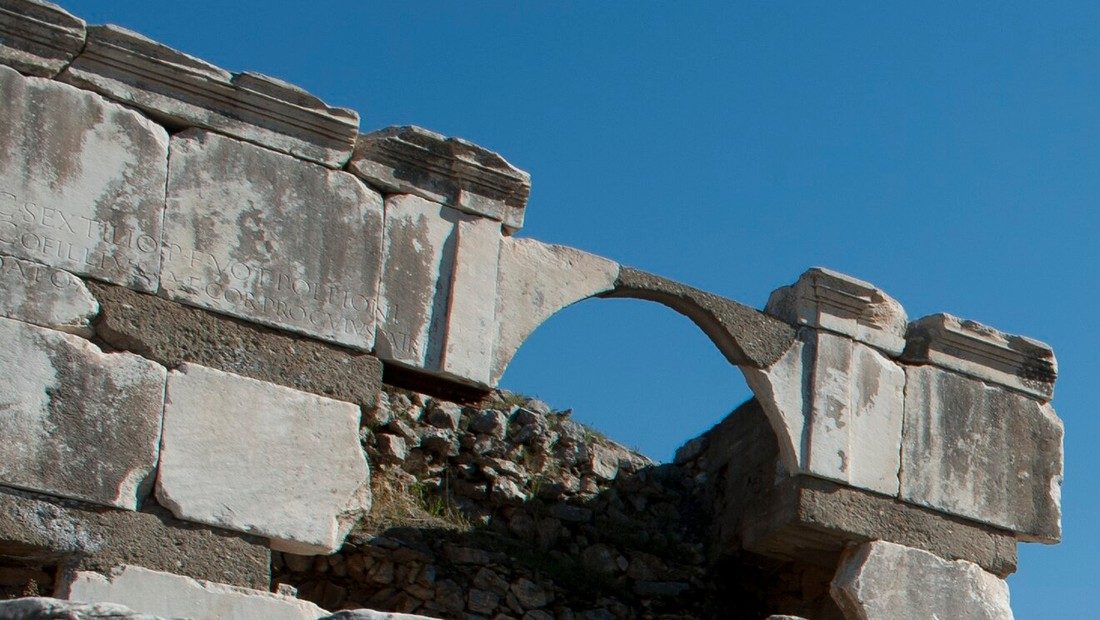
The Fountain of Domitian, AD 92/93
In AD 92/93 a new fountain was built against the south side of Pollio's memorial, and the older monument was folded into it. One founding inscription dedicates the fountain to Artemis of Ephesus and to the emperor Domitian. A second names the proconsul of Asia, Publius Calvisius Ruso: it says the people of Ephesus brought in "Domitian water" under him, and that he oversaw the work and dedicated it. After the emperor was murdered in AD 96, his name was chiseled out of that text, part of the same campaign of erasure told on our Temple of Domitian page.
Other inscriptions from Ruso's year say the city brought the waters of the Marnas and the Klaseas into Ephesus at its own expense, again with Ruso overseeing. Who paid for the fountain itself is still debated. Some studies call Ruso its donor. Others point out that the surviving inscriptions credit the people and the city of Ephesus with the work and name Ruso as the governor who oversaw and dedicated it, not as the payer.
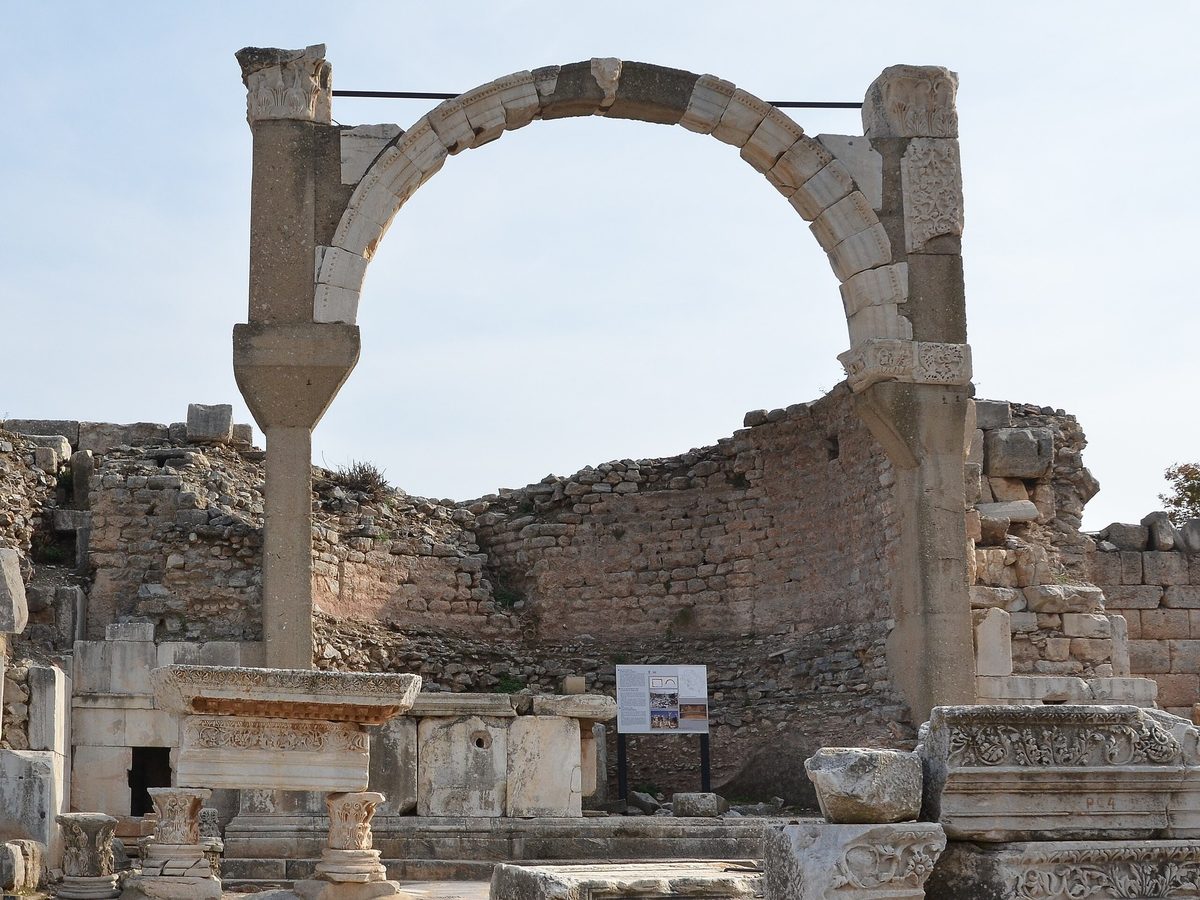
It was a semicircular fountain: an apse with a straight front, standing on a three-stepped base. The basin was 6.28 meters across, and patches of its red waterproof mortar survive. A screen of upright marble slabs about 9.5 meters long closed the front, and four marble pillars and the arch stood on it. The columns beside the arch were carved top to bottom with deeply drilled tendrils, their capitals grow female heads out of acanthus leaves, and a female head decorated the keystone too. A concrete vault faced with marble roofed the basin and gave it the look of a cave, which suits the scene it held.
Behind that screen the water was out of reach, so a smaller draw basin in front served people passing by. Fountains of this semicircular type were common in the western half of the empire but rare in Asia Minor at the time, and the vaulted basin was unusual here too. The arch you photograph today is a modern re-erection in concrete and marble that marks where the original stood.
One more fountain belonged to the complex: a U-shaped fountain built on top of the Pollio Monument and facing the State Agora, known today from its foundations, its water installations and pieces of its architecture. Studies of the site call it the Nymphaeum of Pollio, and that name often spreads to the whole complex.
Odysseus and the Cyclops
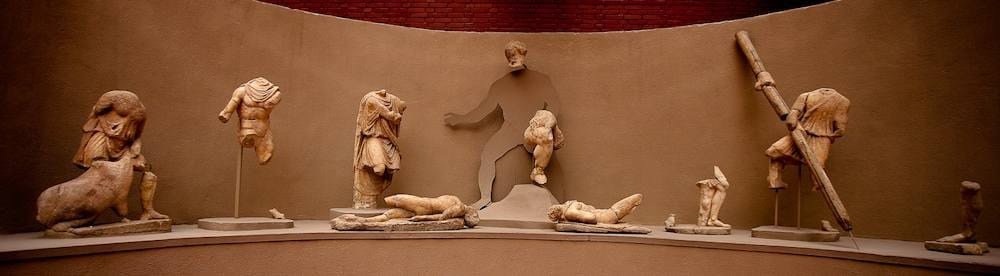
On a curved pedestal above the water stood the showpiece of the fountain, a marble scene from Homer's Odyssey. Odysseus offers the one-eyed giant Polyphemus a cup of wine, a companion carries the wineskin, others hold and sharpen the stake, and dead companions lie on the ground. It is the moment before the blinding, not the blinding itself. Polyphemus was larger than life, almost twice the size of the men around him.
The statues are older than the fountain by more than a century. They are Late Hellenistic work of the 1st century BC, brought here from another monument, and holes for water pipes were cut into them, hastily, when they were reused: water ran from openings in the wineskin and in the back of one of the men carrying the stake.
Where the group stood first is an open question. One reconstruction puts it in a temple pediment on the State Agora; another argues the figures were made to be seen at eye level, in a villa garden or a grotto like the one the emperor Tiberius used at Sperlonga in Italy. The scene was a favorite in imperial villas, yet no other fountain in Asia Minor is known to have carried it. Here it stood on a public street, in front of everyone.
Where are the Polyphemus statues now?
In the Ephesus Museum in Selcuk. Austrian archaeologists under Franz Miltner excavated the fountain in the late 1950s and found most of the fragments in the basin, where they may have fallen from the niche, perhaps after a fire. Years under water marked the marble, which is one reason the group cannot be fully restored. When the group was set up in the museum in 1976, the surviving figures were mounted in a purpose-built curved niche, and the giant, of whom only fragments survive, such as his head and the thigh with a dead companion lying across it, was rendered as a flat outline. The museum was re-displayed in 2014, and today the group belongs to its hall of fountain finds.
Look in the same museum for a young man half-reclining against a rock with a small shield and a short sword, found at the same fountain complex. The Ministry of Culture and Tourism calls him the Resting Warrior; one scholarly proposal identifies the same statue as Marnas, the river god of one of the streams that brought water to the city. Same marble, two names. The Ephesos Museum in Vienna holds other finds from the Austrian excavations, but not this group.
How to find it
Come in by the Upper Gate, as most of our tours do. The path takes you past the State Agora and the Basilica Stoa, the Odeon and the Prytaneion, and then opens onto Domitian Square. The Pollio Monument and the fountain stand against the west retaining wall of the State Agora, facing the square, with the terrace of the Temple of Domitian along the south side of the square. Stand in the square and face the apse: the rough block on the left is Pollio's memorial, and the arch and the curved basin on the right are the Fountain of Domitian.
The Fountain of Laecanius Bassus, the Water Palace, stands by the same agora a short walk away, and the two are worth comparing: a reservoir dressed as a palace, and a grotto dressed as a stage. From the square the route continues through the Hercules Gate and down Curetes Street to the Fountain of Trajan, dedicated a decade or two after this one.
Starting at the Lower Gate instead? Then the fountain is at the far, uphill end of the walk, so check that your route goes all the way up; our Upper Gate or Lower Gate guide explains the choice. If inscriptions and building phases are your kind of thing, our archaeological Ephesus tour walks this route from the Upper Gate at an unhurried pace, and the Ephesus Museum can be added to the day.
Sources & further reading
- Text of the Pollio Monument and Fountain of Domitian information panel at Ephesus — the official panel at the monument: dates, measurements and the statue group
- Ministry of Culture and Tourism: Ephesus Museum — the museum in Selcuk and its hall of fountain finds
- Milliyet: "Efes'in zenginliği bu müzede saklı" (2024, in Turkish) — the museum's 2014 re-display and the Pollio group in the hall of fountain finds
- UNESCO World Heritage Center: Ephesus — the official World Heritage listing
Keep reading
See all attractions around EphesusFountain of Trajan
A monumental fountain with the emperor's foot on the globe — proof in marble that the Romans knew the earth was round.
Fountain of Gaius Laecanius Bassus
The Water Palace at the top of Ephesus: a working reservoir dressed as a monument, built about AD 80 and the model for later fountains such as the Fountain of Trajan.