

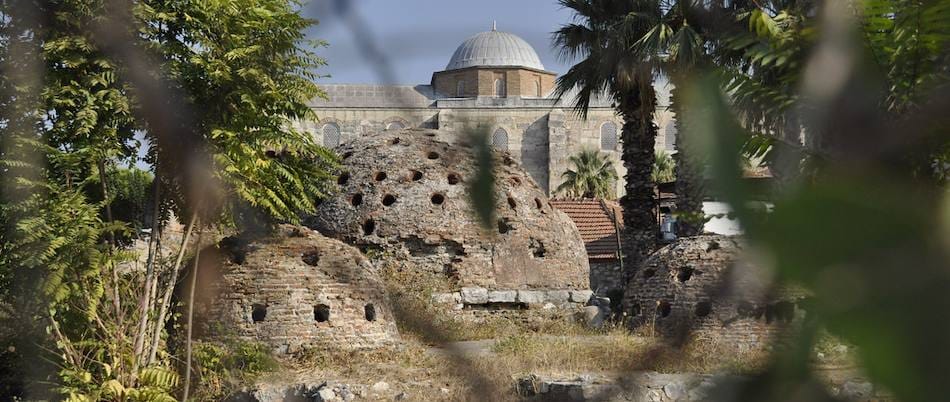
Ayasuluk Hill is the fortified hill in the middle of Selcuk, about 3 km from the ruins of Ephesus, and it is three things at once: the site of Apasa, the Bronze Age town that became the first Ephesus; the platform of Justinian's Basilica of Saint John; and the castle — call it Ayasuluk Fortress, Ayasuluk Citadel or simply Selcuk Castle — whose walls crown the skyline. Its excavators speak of roughly 9,000 years of continuous settlement.
Ayasuluk Hill: the first Ephesus
Long before Lysimachus laid out the marble city in the valley, the hill above modern Selcuk was Apasa, capital of the kingdom of Arzawa known from Hittite records. Excavations have found a Late Bronze Age fortification wall deep under the later church, tombs cut into the slope, Mycenaean pottery, and in 2022 a 3,200-year-old Mycenaean statuette about 5 cm tall. Greek settlers founded their Ephesus here around 1000 BC; the city moved down to the plain in the 300s BC and, when the harbor died, climbed back up in the 600s AD. The name Ephesus itself probably descends from Apasa — the story is in our page on the meaning of Ephesus.
Ayasuluk Castle: the citadel on top
The fortress was built after the Arab raids of the 7th century to protect the basilica below it, and was patched and reused by everyone who held the hill afterwards — Byzantines, the Turkish emirs of Aydin and the Ottomans. Its walls are a masonry diary of all of them. Inside the restored ramparts are a small mosque, a chapel and cisterns; around them runs the finest view in the region: Selcuk's red roofs, the basilica terraces, the lone column of the Temple of Artemis, storks on every pinnacle from mid-March to late August and, on a clear day, the Aegean shining beyond the plain that used to be the sea.
The Basilica of Saint John on the slope
Below the castle lies the reason the hill kept its importance: the Basilica of Saint John, built in the 6th century under Emperor Justinian over the tomb of the apostle, about 130 m long and modeled on the Church of the Holy Apostles in Constantinople. Around 1308, when the town fell to the Turkish Beylik of Menteshe, it was turned into a mosque; the Isa Bey Mosque of 1375, built partly from its marble, still stands a few hundred meters downhill.

What the name Ayasuluk means
Ayasuluk is what centuries of Turkish pronunciation did to the Greek Agios Theologos, "the Holy Theologian" — Saint John, whose basilica made the hill a place of pilgrimage. The town at its foot kept that name until 1914, when it was renamed Selcuk after the Seljuk Turks. So the hill's name is a 1,500-year-old game of telephone that still says exactly whose hill it is.
How to visit Ayasuluk Fortress
- From Selcuk: the entrance is a short walk uphill from the town center, next to the Isa Bey Mosque. The Basilica of Saint John site is a Ministry site with a €6 ticket for foreign visitors (updated September 2026); the castle is reached from the same hill.
- From Ephesus: about 3 km, six to ten minutes by car — most of our tours drive up after the ancient city, or stop at the viewpoint in front of the basilica first.
- When: late afternoon, when the light turns the stone honey-gold and the swifts take over the ramparts; or first thing in the morning, before the port coaches arrive.
- What to bring: water and a hat — the hill is open and there is little shade on the walls.
Sources & further reading
- Wikipedia: Ayasuluk Hill — name, Bronze Age finds and the fortress, cross-checked
- Wikipedia: Basilica of St John — the church on the hill
- Daily Sabah, June 2022 — the Mycenaean statuette — the 2022 excavation find
- UNESCO World Heritage Center: Ephesus — Ayasuluk Hill is part of the listed property
Keep reading
See all attractions around EphesusEphesus Museum in Selcuk
Home of the famous Artemis statues, gladiator reliefs and the emperor's colossal head — Ephesus's portable treasures under one roof.
Sirince Village near Ephesus: Wine, Lanes and a Lazy Afternoon
Whitewashed houses, fruit wines and lazy lanes 8 km above Selcuk — what to do in Sirince and how we pair it with Ephesus in one private day.