
Ephesus has no agreed meaning in Greek. Most scholars now trace the name to Apasa, a Bronze Age city of the Hittite era that probably stood on Ayasuluk Hill, under today's Selcuk. Efes is simply the Turkish form of the same name, and in English you say it EF-uh-sus, with the stress on the first syllable.
What does Ephesus mean?
Honestly, nobody knows for sure, and that is the scholarly answer, not a dodge. The Greek lexicons give the name no meaning: Strong's Greek dictionary (G2181) calls it "probably of foreign origin" and Thayer's "of uncertain origin". The word was already old when Greek settlers arrived on this coast, and they simply kept saying it.
The oldest trace is Apasa, capital of the kingdom of Arzawa in Hittite records. Its site is believed to be Ayasuluk Hill, the fortified rise above Selcuk. The Bronze Age walls lie largely under the Basilica of St John; a 1996 excavation hit the Late Bronze Age fortification wall 3.3 m down.
The dig keeps adding pieces: a rescue excavation on the hill in 1960 found a Late Bronze Age grave with Mycenaean vessels. Most scholars now accept that Greek Ephesos is the same word as Hittite Apasa, worn smooth by a thousand years of use. Keep the word "probably" in that sentence; it is the honest one.
One reading: the later city
What did Apasa itself mean? One reading treats the Luwian form Apa-sa as "later-city", from a prefix meaning "behind, after" that is related to Greek epi. So Ephesus may once have meant "the later place" or "the town beyond". Treat it as a possibility, not a fact; it is the only gloss the sources offer.
The Amazon legend
Greek writers preferred a better story. The traditional founder is Androklos of Athens, around the 10th century BC. Later historians handed the founding to Ephos, queen of the Amazons. It is myth, not history, but it suits a city whose great goddess, Artemis of Ephesus, carried a name far older than the Greeks who worshipped her.
Not from the bee
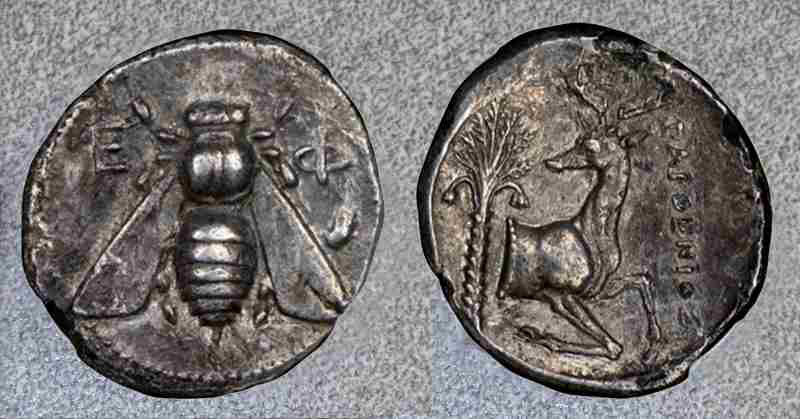
You will see a bee everywhere here: on the ancient coins in the Ephesus Museum and on the belt of the Artemis statue in the same hall. That is the city's emblem, not its etymology. The idea that Ephesus comes from Latin apis, "bee", is commonly rejected; the name is centuries older than any Roman.

Efes meaning in Turkish
Efes is simply the Turkish name for Ephesus. It is not a translation and it carries no separate meaning of its own: Turkish took the word from Byzantine Greek Ephesos by way of Ottoman Turkish and kept it to two syllables. If you have searched "Efes ne demek" ("what does Efes mean"), that is the whole answer.
You will meet the short form all day. The brown road signs from Kusadasi and Selcuk say Efes; Turkish signs and guidebooks call the ruins Efes Antik Kenti, the Ephesus Ancient City; the museum in Selcuk is the Efes Museum. Say Efes to any taxi driver on this coast and you will be taken to the right gate.
Efes beer: named after the city
Yes, the beer takes its name from Ephesus. Efes Pilsen was first brewed in 1969 at the group's Istanbul and Izmir breweries and has been Turkey's leading beer brand since the 1980s. The founders reportedly wrote three candidate names on slips, drew one by lot, and kept Efes because it was short and easy to say.
The name traveled further. The Istanbul basketball club founded in 1976 played as Efes Pilsen until May 2011, when a regulation banning alcohol advertising in sport turned it into Anadolu Efes. So a Bronze Age place name now sits on beer labels and basketball shirts, and our guides are happy to be asked about either.
Ephesus in Greek, Latin and English
In Ancient Greek the name is written Ἔφεσος, romanized Éphesos. Latin borrowed it as Ephesus, a second-declension feminine noun, and English took the Latin spelling unchanged. The adjective gives us Ephesian and Ephesians, the title of Paul's New Testament letter. Every modern European form is the same word in local dress.
| Language | Form of the name | Note |
|---|---|---|
| Ancient Greek | Ἔφεσος (Éphesos) | the form on the inscriptions and in the New Testament |
| Latin | Ephesus | feminine noun; the source of the English spelling |
| English | Ephesus | said EF-uh-sus; adjective Ephesian |
| Turkish | Efes | via Ottoman Turkish from Byzantine Greek |
| Modern Greek | Éfesos | said with an f, as in Byzantine times |
| French | Éphèse | same Latin root |
| Italian | Efeso | same Latin root |
The sound of the Greek changed over the centuries, which is why Ephesus and Efes look different but are one word. Wiktionary's reconstructions run from 5th-century BC Attic /é.pʰe.sos/, with a breathy p, through 1st-century AD Egyptian Koine /ˈe.pʰe.sos/ to 10th-century Byzantine /ˈe.fe.sos/. The ph softened into f, and Turkish simply wrote down what it heard.
Saying the name, in brief
In English, EF-uh-sus, with the stress on the first syllable; in Turkish, Efes, roughly EH-fess. Stress, spelling, the Greek form and how to read Ephesians aloud are all on our Ephesus pronunciation guide.
Does Ephesus have a meaning in Hebrew or the Bible?
No. Ephesus is not a Hebrew word; it is the Greek rendering of an older Anatolian name. Strong's G2181 lists it as "probably of foreign origin" and defines it simply as a city of Asia Minor. The "Hebrew meaning: desirable" that circulates on baby-name sites has no basis in the lexicons.
What the name does carry is biblical weight. Ephesus is named 16 times in the Greek New Testament, in Acts, 1 Corinthians, Ephesians, 1 and 2 Timothy and Revelation; count "Ephesians" as well and you reach about 20. Paul lived here for roughly three years, around AD 52 to 55 (Acts 20:31).
Tradition holds that Paul wrote the Epistle to the Ephesians from prison in Rome around AD 62. Revelation 2:1–7 addresses the church of Ephesus first among the seven churches of Asia, and church tradition places the apostle John and his letters here, hence the Basilica of St John on Ayasuluk Hill.
And Selcuk?
The modern town beside the ruins is named Selcuk, after the Seljuk Turks. Before that it was Ayasuluk, a Turkish wearing-down of the Greek Agios Theologos, "Saint John the Theologian", whose basilica crowns the hill. The hill itself is the probable site of Apasa, so the story of the name ends where it began.
The medieval skyline is still there: the Isa Bey Mosque of 1375, built for the Aydinid ruler Isa Bey, and the Ayasuluk Fortress above it, mainly Byzantine, patched and reused by Seljuks and Ottomans. Locals use Efes and Selcuk almost interchangeably. The town center is about 3 km from the lower gate, a 35–40 minute walk or a few minutes by car.

Whichever name you use, the place is the same: Ephesus on your ticket, Efes on the sign, Ephesos on the stones. Say EF-uh-sus at the gangway, Efes to the driver, and let the licensed local guides on our private Ephesus tours tell you the rest between the two gates. We reply to every inquiry within 24 hours, any day, and there is no prepayment.
Sources & further reading
- Encyclopaedia Britannica: Ephesus — overview of the city's history
- Strong's Greek 2181, Ephesos (Bible Hub) — lexicon entry: origin, and all 16 New Testament occurrences
- Wiktionary: Ἔφεσος — Greek pronunciation by period and the descendant forms, including Turkish Efes
- Perseus Digital Library, Tufts University — ancient sources in Greek and translation
Keep reading
See all Ephesus travel articlesThe Decline of Ephesus: Why the City Was Abandoned
Why Ephesus was abandoned, when it fell and what happened to the city: silt, earthquakes, Goths, Arabs and a slow move uphill, with dates.
Alexander the Great, Lysimachus and the City That Moved
Alexander offered to rebuild the burned wonder; the Ephesians talked their way out. Then his general moved the whole city — with plumbing as the weapon.