

Modern day Ephesus is Selcuk, a town in Izmir Province on Turkey's Aegean coast. The ruins of the ancient city lie about 3 km from Selcuk town center and 18–20 km from Kusadasi cruise port. Ephesus itself is no longer a living city: it is an archaeological site, open every day, and Selcuk is the town beside it.
Where is modern day Ephesus?
Modern day Ephesus is in the Selcuk district of Izmir Province, western Turkey, a few kilometers inland from the Aegean Sea and across the water from the Greek island of Samos. The ancient city stands at the edge of the Kucuk Menderes plain, between Ayasuluk Hill on the Selcuk side and Bulbul Dagi, Mount Nightingale, to the south.
The sea is no longer at the door. The harbor silted up centuries ago, and the nearest coast today is Pamucak beach, 6 km north of the site. Cruise ships dock at Kusadasi, 18–20 km to the south-west; Izmir, the provincial capital, is about 80 km north.
| From | Distance to Ephesus | Time by road |
|---|---|---|
| Selcuk town center | about 3 km | 6–10 minutes by car; 30 minutes on foot |
| Kusadasi cruise port | 18–20 km | 20–30 minutes; up to 45 in peak season |
| Sirince village | 8 km east of Selcuk | about 15 minutes |
| House of the Virgin Mary | about 7 km from Selcuk | a short uphill drive |
| Izmir Adnan Menderes Airport (ADB) | about 60 km | about 45 minutes |
| Izmir city center | about 80 km | about 1 hour 15 minutes |
| Bodrum | 160 km | about 2.5 hours |
| Pamukkale | roughly 200 km | 3–3.5 hours |
| Istanbul | fly to Izmir (ADB), then about 60 km | flight, then about 45 minutes |
What is Ephesus called today?
Ephesus is called Efes today. Efes is the Turkish form of the ancient name, and it is the word on every brown road sign and ticket between Kusadasi, Izmir and the site. The town beside the ruins is Selcuk, and the district that contains both is also called Selcuk.
The town took the name Selcuk in 1914, after the Seljuk Turks. Its older name, Ayasuluk, is a Turkish form of the Greek Agios Theologos, Saint John the Theologian, whose tomb and basilica stand on the hill above the town. People here still call the hill Ayasuluk.
| Name | Who uses it |
|---|---|
| Ephesos | Ancient Greek and the New Testament |
| Ephesus | Latin and English |
| Efes | Turkish: road signs, tickets, the Efes Museum |
| Selcuk | The modern town and district, named in 1914 |
| Ayasuluk | The old name of the town; now the hill and its fortress |
| Apasa | Probable Bronze Age name, capital of Arzawa |
Is Ephesus still a city today?
No. Ephesus is not a living city today. It is an archaeological site, a UNESCO World Heritage Site since 2015, and nobody lives inside it. The living town is Selcuk, about 3 km away, with about 38,500 people in the district (TurkStat, 2025). The site is open to visitors every day.
The city did not so much die as move. Settlement began on Ayasuluk Hill, shifted to the present site in the 300s BC, and came back to the hill in the 7th century AD after the harbor silted up. Why it emptied is told in the decline of Ephesus.
Austrian archaeologists have excavated the site since 1895, and after more than 130 years of Austrian excavation only about a tenth of the ancient city has been uncovered. That tenth is what you walk through today: Curetes Street, the Library of Celsus, the Great Theater and the Terrace Houses.

Modern Ephesus: Selcuk, Ayasuluk Hill and the beach
Modern Ephesus, the place people live, is Selcuk: a district of 317 square kilometers with a center around the railway station and the Ephesus Museum. From mid-March to late August its most photographed residents are the white storks, nesting on the piers of the old aqueduct in the town center; a nest can weigh 60 to 250 kilos.
Above the town is Ayasuluk Hill. On it stands the Basilica of St John, a 6th-century church built under Emperor Justinian I over the tomb of the apostle; about 130 m long, it was among the largest churches of its age. Higher up is the fortress, built after the Arab raids of the 7th century.
On the slope below is the Isa Bey Mosque of 1375, modeled on the Great Mosque of Damascus and still a working mosque, so dress modestly. Between the hill and the aqueduct are the tea gardens under the plane trees; several of our guides live within walking distance of them.

The Ephesus Museum in the center holds the finds from the ruins, including the famous Artemis statues. It is open every day, 08:30–20:00 in summer 2026, and costs €10 for foreign visitors; the Basilica of St John is €6, and the Temple of Artemis on the edge of town has no ticket office and is free (updated September 2026).
Pamucak, marked as Ephesus beach on some maps, is 9 km west of Selcuk and 6 km north of the ruins: up to 5 km of sand, up to 80 m wide in places, with a swimming season from May to early October, according to the district governorship.
Sirince, 8 km east of Selcuk and about 15 minutes by car, is the hill village of about 450 people that most visitors pair with the ruins. It was a Greek Orthodox village until the 1923 population exchange, and fruit wine is its best-known product today.
The church of Ephesus today
The church of Ephesus, the congregation Paul wrote to and the first of the seven churches of Revelation, no longer exists as a community. Its places do. Inside the ruins, near the lower gate, stand the walls of the Church of Mary, where the Council of Ephesus met in AD 431.
About 7 km from Selcuk, on Bulbul Dagi, the House of the Virgin Mary is a working Catholic shrine, open every day, 08:00–18:00 in summer and 08:00–17:00 in winter (updated September 2026). Mass is celebrated there every 15 August, and three popes have visited: Paul VI in 1967, John Paul II in 1979 and Benedict XVI in 2006.

Visitors are asked to cover shoulders and knees (wraps can be borrowed at the entrance), and no photography is allowed inside the chapel. The shrine has its own ticket, which no Museum Pass covers; we buy it for you in advance at the gate price, with no mark-up, and it is paid separately rather than included in the tour price. The wider story is in the church of Ephesus and Paul in Ephesus.
Modern day Ephesus map
A map of modern day Ephesus needs two layers: the ancient city between its two gates, and the modern town and roads around it. Our Ephesus map page has both, with a printable PDF to save before you travel; the distance table above covers the roads.
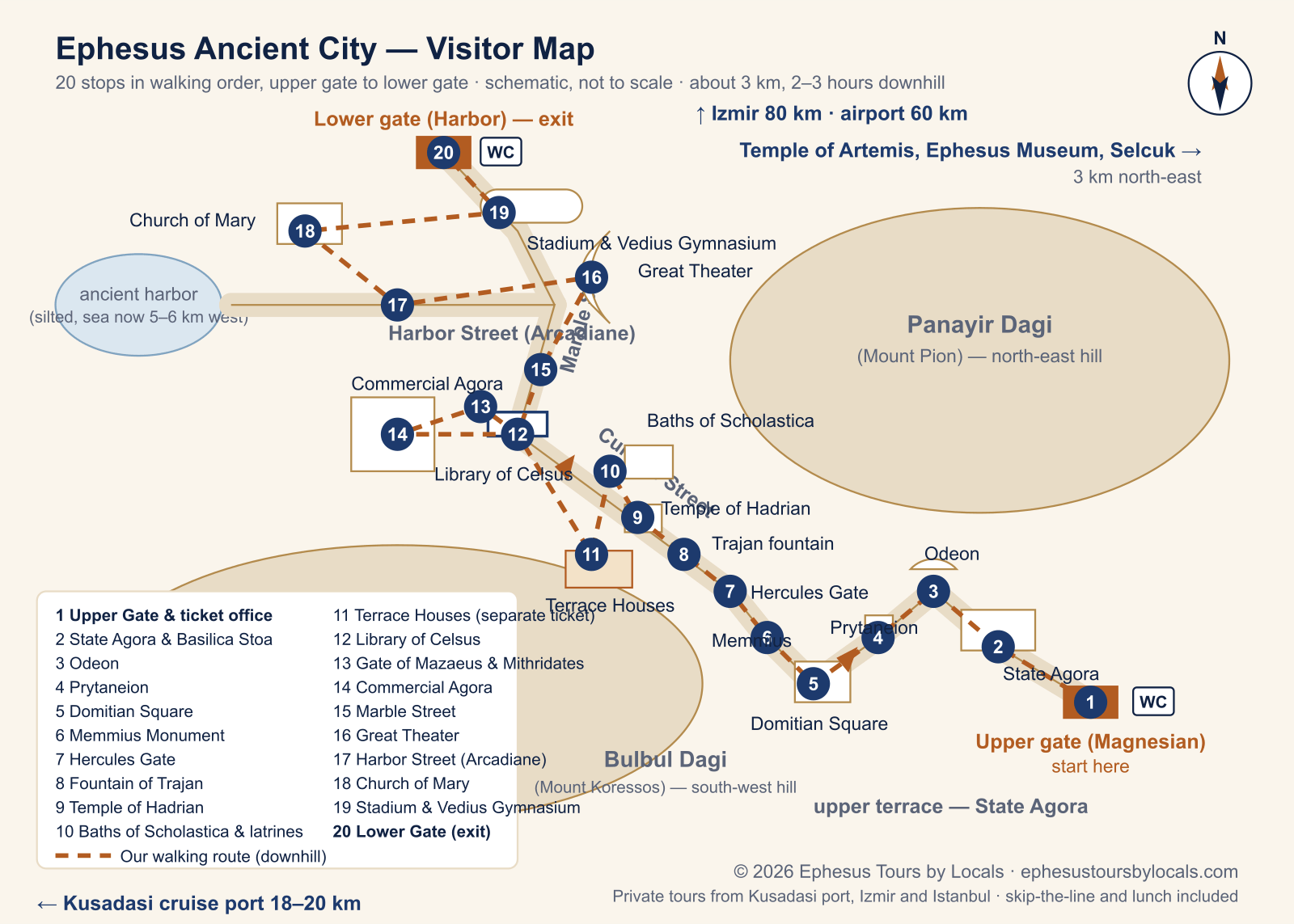
The upper, Magnesia Gate is on the road up towards the House of the Virgin Mary; from it Curetes Street runs downhill past the Odeon and the Terrace Houses to the Library of Celsus, then Marble Street continues past the Great Theater to the lower gate on the Selcuk side. We enter at the top, so the whole walk is downhill.
Both gates have ticket offices and paid car parks. In summer the lower-gate office sells until about 18:45 and the upper-gate office closes at 18:00 (updated September 2026); hours change with the season, so we confirm them the day before your tour. Current prices are on the entrance fees page.
Are Ephesus and Kusadasi the same place?
Kusadasi is a working town with a life of its own. Is Kusadasi a city? It is a sizable resort town, the center of a district of about 141,000 people (TurkStat, 2025), with beaches, a marina, the Öküz Mehmed Pasha Caravanserai of 1618 and Pigeon Island guarding the harbor mouth; the name means "Bird Island". Ephesus has had no residents for more than five hundred years: it is an archaeological site in a different province, and the town that grew up beside it is Selcuk.
On a map, Kusadasi sits on the coast facing the Greek island of Samos, and Ephesus lies inland at the edge of the Kucuk Menderes plain. The road between them runs 18–20 km: 20–30 minutes, and up to 45 on the busiest cruise days. The distance table above has the other towns, and our Ephesus cruise port guide covers tender days and how many hours ashore you need.
On our Kusadasi shore excursion that distance is part of the plan: your guide meets you at the port exit, where the pier meets the town, and a private air-conditioned vehicle takes you straight to the upper gate of Ephesus.
Visiting modern day Ephesus from Kusadasi port
From the cruise port the visit fits in half a day: 18–20 km each way, a downhill walk through the site and lunch before you are back at the gangway. This is how a private tour with us runs.
- We meet you at the gangway with a name sign, or at any hotel, port or airport in Kusadasi, Selcuk or Izmir.
- Drive 18–20 km to the upper gate: 20–30 minutes, up to 45 on peak days.
- Enter with skip-the-line tickets we bought in advance at the Ministry gate price, no mark-up; tickets are paid separately and are not included in the tour price.
- Walk downhill through the ancient city with a licensed local guide, in English, Spanish, Portuguese, French, Russian, Italian or German, then lunch at a local artisan center: whatever is local and fresh, cooked by local chefs.
- Back at the gangway on time, guaranteed. No prepayment, so no cancellation fee; we reply within 24 hours, any day.
A question this page does not answer? Write to info@ephesustoursbylocals.com or use the booking form; our office is open 08:00–20:00 every day.
Sources & further reading
- UNESCO World Heritage Center: Ephesus — World Heritage listing of the ancient city, Ayasuluk Hill and the House of the Virgin Mary (inscribed 2015)
- Turkish Statistical Institute (TurkStat): 2025 population results — address-based population figures for every province and district, including Selcuk (Izmir) and Kusadasi (Aydin), released February 2026
- Selcuk District Governorship: Pamucak beach — official description of the beach, its size and swimming season
- Encyclopaedia Britannica: Ephesus — the ancient city, its harbor and the Council of AD 431
Keep reading
See all Ephesus travel articlesEphesus Pronunciation: How to Say Ephesus, Efes and Ephesos
How to pronounce Ephesus (EF-uh-sus), Ephesians, the Turkish Efes and the Greek Ephesos, and how to spell the name, from guides who say it every day.
Ephesus Meaning: Origin of the Name and What Efes Means
What Ephesus means, where the name comes from, and what Efes means in Turkish, from guides who say it every day.