
Most of Ephesus had to be dug out of the ground. The prize of St. Paul's Grotto was hidden in plain sight, under a coat of plaster. In 1998, conservators taking down that later layer inside a small cave chapel on the mountain above the ruins found an older painted surface underneath, and on it a man whose Greek label named him: Paul.
What was under the plaster
The cave is narrow and only about fifteen meters deep, yet Christians used and honored it as a place of prayer across many centuries. They plastered its walls, painted them, and later painted over them again. Every new coat sealed the one beneath it, which is why the oldest pictures waited so long to be seen.
The best-known scene, dated to around the 6th century, is not a Bible story. Its source is a 2nd-century apocryphal text, the Acts of Paul and Thecla. Paul teaches; Thecla, a girl from Iconium, follows his words from a window; and Theoclia, her mother, objects with an urgent gesture. The painter made Thecla as large as Paul and gave her the same lifted, teaching hand, a choice scholars read as putting the two on equal footing. At some later date, somebody scratched away Thecla's eyes and her raised hand.
Paul's face is the other reason historians care. He has a high forehead and bald crown, a dark pointed beard and a long nose: the look the Acts of Paul gives him, and the one icon painters went on using for centuries afterward. Few pictures of Paul anywhere in the world are older. The plaster around the figures is crowded with writing too, hundreds of prayers that Byzantine pilgrims cut into the wall, a great many of them asking Paul by name for help.
Why the cave stays closed
The grotto is closed to visitors for conservation; no reopening date has been announced (October 2026). It is not hard to see why. Everything that makes this place important lives in its plaster: the paintings in their stacked layers, and the pilgrims' prayers scratched into the same surface. Damage that skin and the evidence goes with it, and a cave this narrow leaves little room to keep shoulders, bags and fingertips off the walls.
The frescoes were documented by the Austrian Archaeological Institute's Ephesus excavation team, and what we know of the scenes comes from that work. We prefer to say all this plainly, before anyone plans a day around the cave. If the status changes, we will update this page.
Where it sits above the city you walk
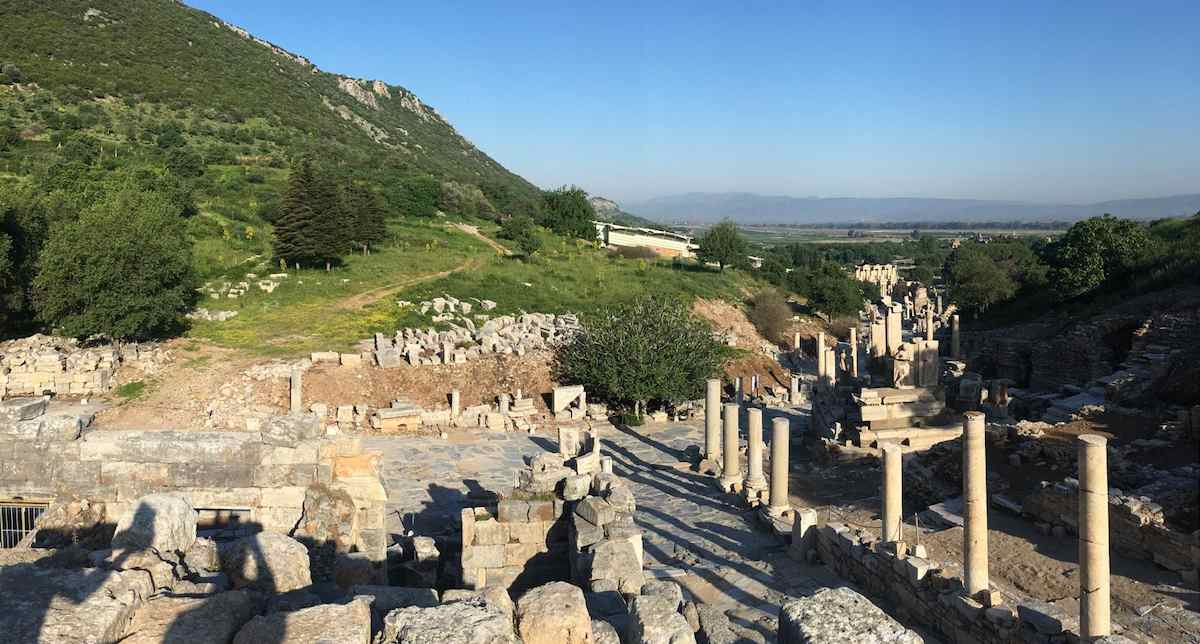
Most of our guests start at the upper gate and walk downhill along Curetes Street toward the Library of Celsus. The green mountainside rising on your left as you descend is Bülbül Mountain, Bülbüldağı in Turkish and Koressos to ancient writers; the Terrace Houses climb its lower slope under their white roof. The grotto lies high up on that same north-facing slope, above the ruins and away from the visitor route. When guests ask where it is, the honest answer is a finger pointed at the hillside, not a turn down a path.
What you can still see of Paul's city
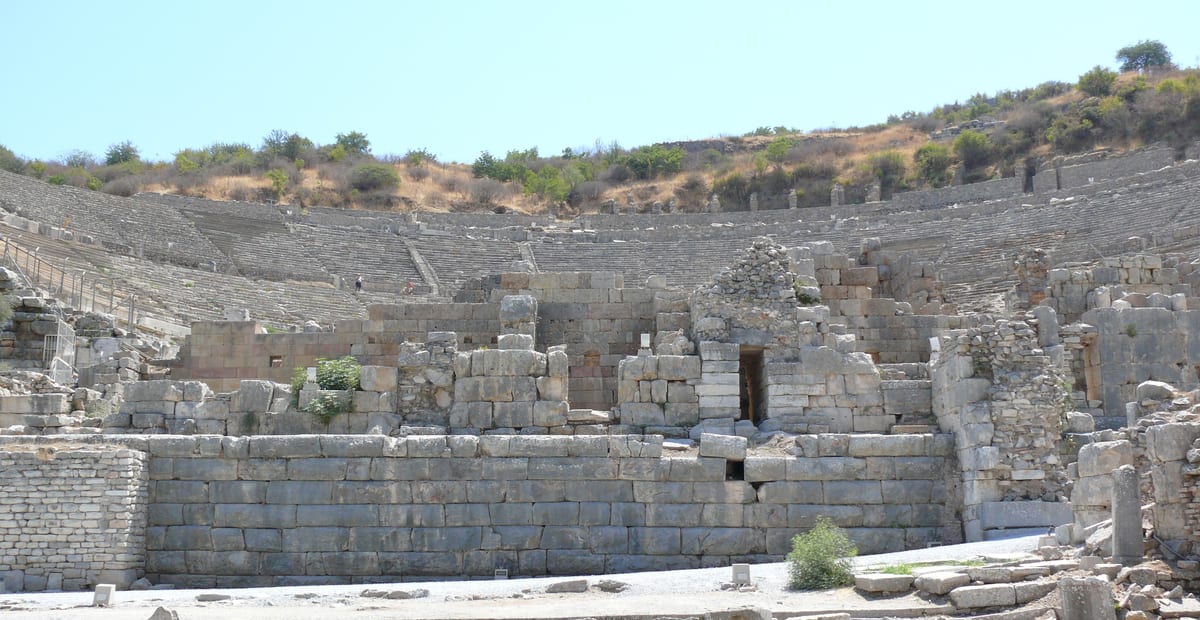
The cave is shut; the city where Paul argued for about three years is not. The Great Theater, where Acts 19 sets the silversmiths' riot, is open, and you can stand in the seats where that crowd shouted for Artemis. Close by, the Commercial Agora was the market whose traders felt his preaching in their profits. Later, the congregation he founded turned a vast Roman hall near the harbor into its great church, the Church of Mary. For the whole story in order, from the synagogue to the riot to the letters, read our article on Paul in Ephesus.
Sources & further reading
- Austrian Archaeological Institute (ÖAI) — the Ephesus excavation team that documented the grotto frescoes
- Encyclopaedia Britannica: Saint Thecla — the saint painted beside Paul
- Encyclopaedia Britannica: Saint Paul the Apostle — Paul's life and missions
Keep reading
See all attractions around EphesusCave of the Seven Sleepers
The grotto where seven persecuted youths reportedly slept for two centuries — a legend shared by Christianity and Islam, five minutes from Ephesus.
Ephesus Experience Museum
An immersive projection museum standing between the Great Theater and the Library of Celsus. What happens inside, who loves it, who should skip it.