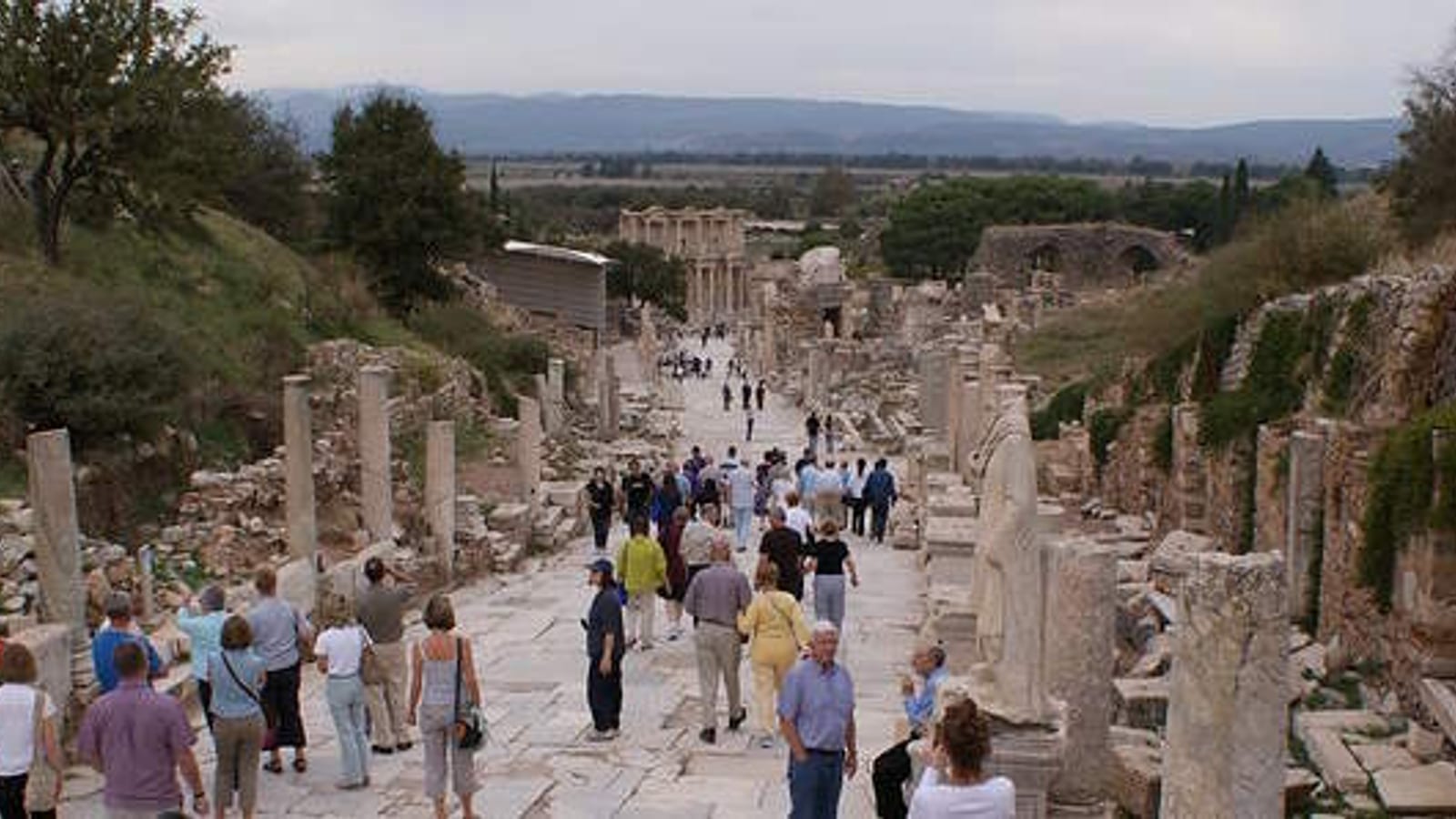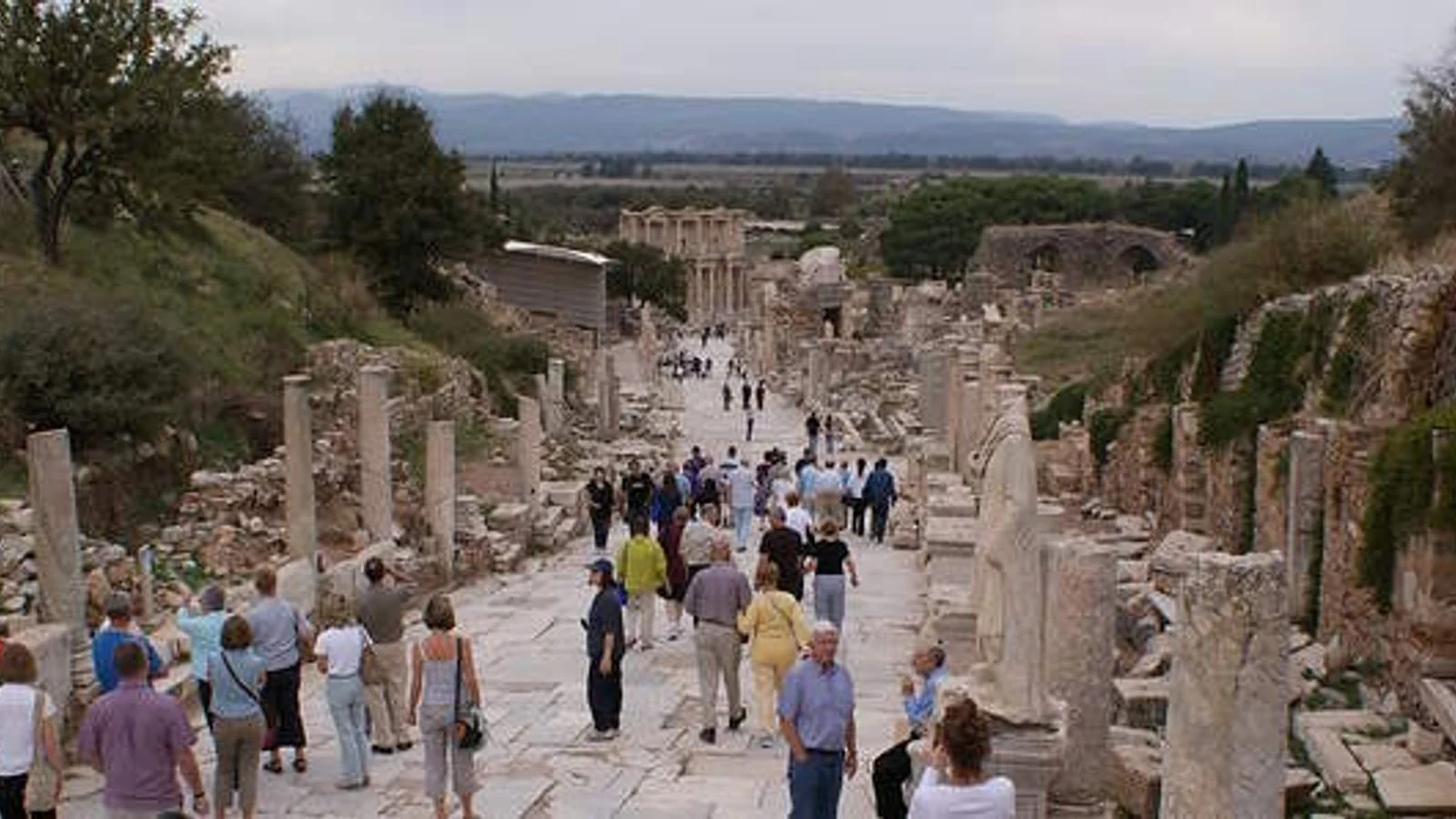
This is one of the two questions we are asked most often, usually in an email that begins slightly apologetically: "Can we just visit Ephesus on our own?" The honest answer — from people whose living depends on the opposite answer — is yes, absolutely you can. Ephesus is a public archaeological site with a ticket booth, a car park and a signposted route. Nobody will stop you at the gate.
But "can you" and "should you" are different questions, and the second one depends entirely on who you are and how much time you have. So here is the version we would give a friend, with nothing hidden.
What visiting Ephesus alone actually looks like
You arrive at one of two gates. You buy a ticket (current prices are on our Ephesus entrance fees page, updated for 2026). You walk in. The site is large — roughly a 1.5-kilometre downhill walk if you enter from the upper gate — and the main route is impossible to lose: there is essentially one marble street, and everyone is on it.
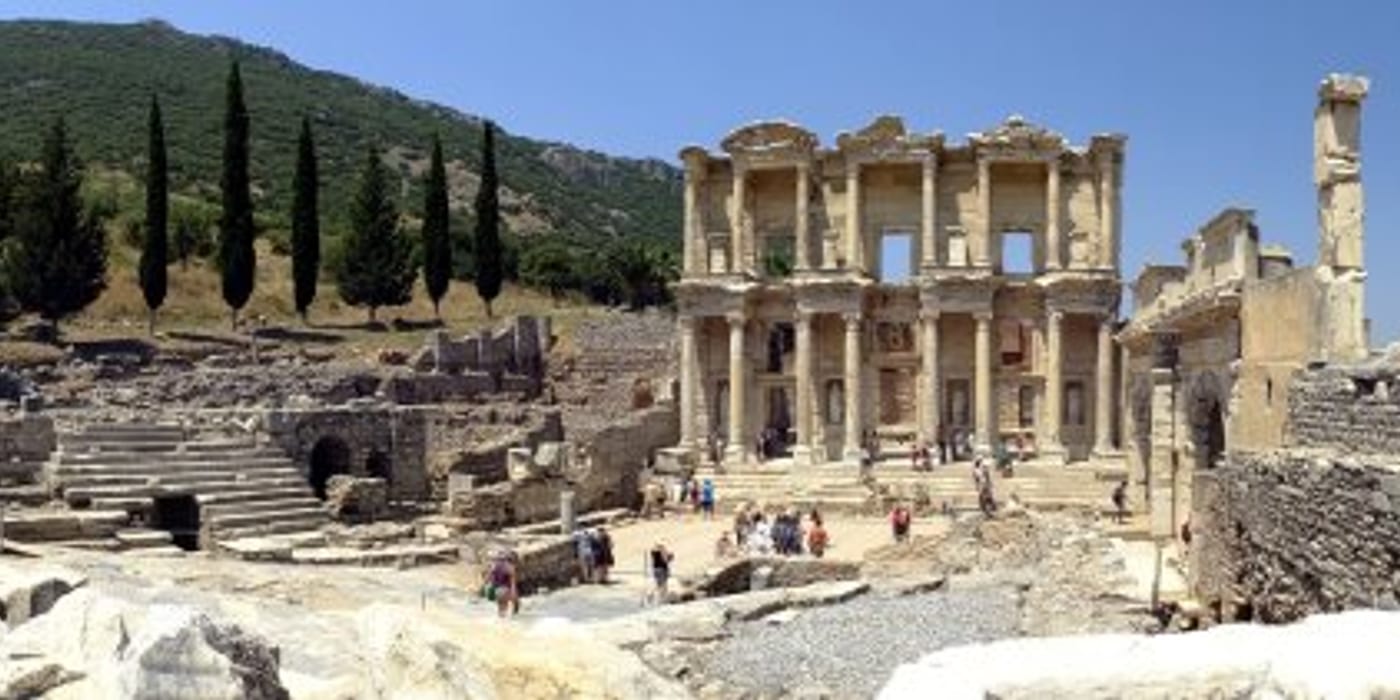
Along the way you will find information boards at the major monuments, in Turkish and English. They are factual, brief, and — being honest — dry. They tell you that the Library of Celsus was completed around AD 117 and held up to 12,000 scrolls. They do not tell you that the man it commemorates is still buried underneath it, in a crypt below the floor, which is almost unheard of for a Roman building inside city walls.
You will see the big things and you will enjoy them. The Great Theater is overwhelming whether or not anyone explains it. Nobody needs a guide to be impressed by a 25,000-seat auditorium.
When going alone is genuinely the right choice
We will happily talk people out of booking us. Go independently if:
- You are an experienced ruins traveler. If you have done Pompeii, Delphi and Jerash and you read site plans for fun, you will do fine and enjoy the freedom.
- You want to photograph, not learn. Photographers often prefer to move at their own strange pace — twenty minutes on one doorway, then nothing for an hour. A guide is a poor fit for that.
- You are on a tight budget. A ticket costs far less than a ticket plus a private guide. If the choice is "self-guided Ephesus" or "no Ephesus", go by yourself. Truly.
- You have already been. Second visits are often best done alone, wandering the corners you skipped.
If that is you, take this advice at least: enter through the upper (Magnesia) gate so the whole site runs downhill, and start either at opening or after 3pm. Our article on the best time to visit Ephesus explains the daily crowd rhythm in detail, and how to get to Ephesus covers the transport from Kusadasi, Izmir and Selcuk.
What you actually lose without a guide
Now the other side, and I will keep it concrete rather than salesy. Three things disappear when you walk alone.
1. The ninety percent you cannot see
Only about ten percent of Ephesus has been excavated. What you walk through is a fragment of a city that held perhaps 200,000 people. Standing on Curetes Street, you are looking at a strip of marble — unless someone rebuilds the shops, the awnings, the lamp-lit night traffic and the sewer running beneath your feet in your imagination. That reconstruction is most of what a guide actually does, and no information board attempts it.
2. The small things nobody points out
The menorah scratched into the library steps. The footprint advertisement carved into Marble Street. The emperor's foot resting on a globe at the Fountain of Trajan — casual proof that educated Romans knew the earth was round. These are unmarked, unsigned, and about a meter from thousands of people who walk past them every single day.
3. Strategy
This is the underrated one. Which gate, which hour, which direction, when to detour to the Church of Mary because four coaches just unloaded at the library. Independent visitors get the same monuments as everyone else, at the same time as everyone else. That is the real cost, and it is invisible until you are standing in it.
The honest middle ground
There are two options between "alone" and "private guide" that we genuinely recommend to people who write to us:
- Buy a good guidebook or audio guide and go alone. Not as good as a person, considerably better than the boards. Read the night before, not while walking.
- Hire a licensed guide at the gate for an hour. Official guides work at the entrance. You get the essentials, then explore alone afterwards. Check for the official license badge — this matters, and it is worth knowing that guiding at Turkish archaeological sites is a licensed profession regulated by the Ministry of Culture and Tourism.
A private tour makes most sense in one specific situation: when your time is fixed and short. Cruise passengers are the clearest case — you have perhaps five hours ashore, the ship will not wait, and the difference between a well-timed morning and a badly-timed one is the entire experience. That is exactly why our Kusadasi shore excursion exists. The same applies to a single day flown in from Istanbul.
So: what would we tell our own family?
If they had three days and a curious mind: go alone the first afternoon, wander, get lost, then take a guide the second day and watch the same stones turn into a city. If they had five hours off a ship: take a guide, without hesitation, and spend the saved time actually looking at things instead of navigating.
And if they told us they were going alone regardless? We would tell them the upper gate, the early hour, and where to crouch down to find the menorah. That is what locals do — the ruins were here long before any of us started charging for them.
If you would like a second opinion on your own plan, just write to us. We answer every message personally within 24 hours, and "you do not need us for this" is an answer we give more often than you would think.
Sources & further reading
- UNESCO World Heritage Center: Ephesus — the official World Heritage listing and site boundaries
- Turkish Ministry of Culture and Tourism — Museums — official opening hours and ticketing
- Austrian Academy of Sciences — the institute excavating Ephesus since 1895
- Encyclopaedia Britannica: Ephesus — background on the city's history